Sunday, April 26, 2015

EVOLUTION: ANIMAL KINGDOM ROOTS

THE FIRST ANIMALS

The previous post described a possible link between sponges and cnidarians that had previously been alluded to in a post on July 18, 2013.  In a post before that, I had listed references helpful in understanding the protostome-deuterostome link.  But none to date have mentioned the following reference.

Wainright, Patricia O., Gregory Hinkle, Mitchell L. Sogin, and Shawn K. Stickel.  1993.  Monophyletic Origins of the Metazoa: An Evolutionary Link with Fungi.  Science, 260:340-342.

Their abstract contains the statement that they inferred from their data "that the animals and fungi share a unique evolutionary history and that their last common ancestor was a flagellated protist similar to extant choanoflagellates."  I had not annotated their article in my reference list and just this week ran across the issue with it while looking for something else.

ANIMAL ROOTS

All groups of living organisms were undoubtedly very closely related in their early beginnings.  But their work was probably part of my subconcious in noting the amoeboflagellates were likely precursors of choanoflagellates and the colonial Proterspongia leading to the sponges.

      Proterospongia, a likely intermediate between choanoflagellates and sponges.

      Mastigamoeba, a flagellated, amoeboid protozoan perhaps ancestral to Proterospongia.

The evidence for relationships of plants, fungi, and animals is not very clear.  In that early cluster of living forms, before simple animals and simple plants evolved along with fungi, many overlapping and/or shared features existed.  Wainright et al. did a fine job of using multiple characteristics in their analysis, but a few differences in loss or retention of features could modify the result considerably.  Still their analysis is perhaps the best available given the problems created by thinking used in molecular phylogenies noted in my May 31, 2013 post, "Science screw-up No. 1".

If you are new to this blogsite, the most important new information is scattered through evolution posts attempting to show the unique importance of the Pogonophora in understanding variable rates of evolution and the close link of deuterostomes, such as chordates, to annelid ancestors.  That link was first suggested over a century ago but rejected successively by faulty application of embryological theory, and then by molecular genetic errors as noted in the post referenced in the preceding paragraph.  So you can search through my posts on annelid theory to get the evidence.

Joseph G. Engemann     April 26, 2015


Wednesday, April 8, 2015

CNIDARIA: NEMATOCYST ORIGIN

THE PORIFERA-CNIDARIA-PLATYHELMINTES CONNECTION

Earlier posts have discussed the evolutionary path leading from sponges to anthozoans to hydrozoans to turbellarians.  Gross structural comparisons were major contributors to that understanding.  But the nematocysts, found in the Cnidaria, which are the basis for the phylum name, are such specialized cell organelles, and only produced in the Cnidaria, also contribute to understanding the sequence of the three phylum connection.

When nematocysts are occasionally found in another phylum, they originate from cnidarians preyed upon by those individuals that have them.  Octopuses have been found to use cnidarian tentacle fragments along their own arms to obtain the benefits of nematocyst use.  Some other mollusks digest cnidarians without disrupting the nematocysts which then arrive at their outer surface in a functional state.

Turbellarian rhabdites

The hydrozoan medusa-triclad turbellarian connection indicated by gross morphology fits well with the transition of nematocysts to rhabdites, the peculiar cell organelles in the epidermal cells of turbellarians. The tubule that everts from a nematocyst is no longer evident but the function of the secretions delivered may have survived or been modified to the ones of turbellarian's rhabites.

Nematocyst origin 

Sponges have a plethora of chemicals of use for their protection.  Being attached and lacking much to physically protect them, other than spicules, toxic and other obnoxious chemicals may have provided protection from many types of organisms.  Spicules may have been coated with such chemicals and delivered them to both large and small potential predators.  The discovery of spicules in the apex of some nematocysts or cnidarians provides inspiration for a structural transition from sponge spicule function to cnidarian nematocyst structure as diagrammed below.


A.  A sponge cell with an emphasis on mechanical protection via a spicule.
B.  Improved intermediate stage (hypothetical) with reservoir from chemicals coating spicule.
C.  Selection yielding larger reservoir of chemicals (hypothetical).
D.  Final stage- a nematocyst-containing cell of a cnidarian.

There are other possibilities for nematocyst origin that seem less likely now that some are known to have the apical spicule.  One of those alternatives may have been transition from a choanocyte rather than from a spicule-secreting cell.  It is possible, especially in view of the variety of nematocysts in hydrozoans, that more than one origin did occur, perhaps illustrated by the diagrams below.


In view of the ease of evolving a complex structure from a pre-existing structure as compared to the difficulty of producing it from uniform structure, one of the above sequences seems likely.  A different origin is not impossible, but one or both of the above seem to fit the action of natural selection.

Joseph G. Engemann     April 8, 2015

Friday, March 6, 2015

MISGUIDED - NATURE & SCIENCE

NATURE & SCIENCE MISS THE MARK

I was thinking about my previous post and it seemed to me the obvious answer to determining animal phylogeny stared me in the face.  The data I had cited from Francis S. Collin's book, The Language of God, seemed to provide proof of the point I have been trying to make in many evolutioninsights.blogspot.com  posts.  On page 127 his Table 5.1 compares the liklihood of finding comparable DNA sequences of humans in other organisms.  It makes the comparison, first of protein coding genes from humans with six other species, then randomly selected DNA from between genes of those species.

Human compared        Protein coding        Random DNA
with                             DNA                     between genes

Chimp                         100%                    98%

Dog                              99%                     52%

Mouse                          99%                     40%

Chicken                        75%                       4%

Fruit fly                         60%                     -0%

Roundworm                  35%                     -0%


Your first thought might be that the protein coding genes make more sense to use for determining relationships.  That is probably the rationale the two flawed studies proposing Ecdysozoa (in Nature, 1997) and Lophotrochozoa (in Science, 1995) used in selecting 18S ribosomal DNA.  But there would be stringent selection to keep that DNA from changing, with a proportionality to its functional importance.

The random DNA from non-coding regions would lack selection and thus could change proportional to the number of generations between the two being compared.  Thus if liklihood percentages are apportioned inversely to generation time in constructing the branch lengths from common ancestors, an ancestral tree could be determined better than by any other available method.  Of course, pairwise comparisons would need to be made for each other possible combination of species considered.

Looking at the data in the table, because mice have shorter generation time they would accumulate more changes since our common ancestry and may thus actually be closer in common ancestry to us than the dog, even though there has been greater change in their between genes DNA.  The big jump between the chicken and the mammals is due to the much greater antiquity of the separate lines from early ancestral reptiles.  With very low liklihood of DNA relationship the accuracy of relationship determination is greatly reduced and fossils and anatomical analysis may be more useful.

I would send this as letters to the editors of Nature & Science, but I doubt they would be any more likely to publish them than my previous submissions many years ago.  Too bad, it might have prevented the Ecdysozoa error which put the roundworm and fruit fly in relatively close relationship.  The same method used for the Lophotrochozoa is consequently almost equally erroneous.

Science and Nature are two excellent science journals.  I am puzzled by the fact that the error has not been corrected.  Perhaps others read it much as I have in the past when reading things I am not very familiar with, assuming the research finding are accurate.  I did so despite the fact that long ago I realized not everything in print, or on internet, must be correct.

Joseph G. Engemann   Emeritus Professor of Biological Science, Western Michigan University, Kalamazoo, MI     March 7, 2015

EVOLUTION: QUIET PRE-CAMBRIAN GENES

THE PRE-CAMBRIAN ENVIRONMENT AND ANIMALS

Genes of the Pre-Cambrian can be inferred from common genes and biochemical pathways shared by extant species.  But there is reason for saying that genes that have not left echoes of their voice had an important role in evolution as well.  Those quiet genes, sometimes important for their silence, can also be inferred from analysis of how some characteristics developed, especially the annelid theory of chordate origin that, I maintain, is the best explanation of origin of chordates via pogonophorans and hemichordates.

Introns and exons

Natural selection is effective in eliminating useless features because there will be no selective force maintaining them, other than the chromosomal duplication process.  The portion of the genome active in protein coding is thought to be about 1.5 percent.  The 98.5 percent of the DNA not active in production of RNA needed to produce structural and functional proteins and control substances may have some value in other ways that are less dependent upon their exact nucleotide sequence.  In comparison to human DNA Collins (2006) shows the sequence for protein codes is 100% the same as in a chimpanzee, 75% the same in a chicken, and 35 % in a roundworm; whereas random segments of DNA between the genes only corresponded at rates that were 98% for a chimpanzee, 4 % for a chicken, and -0 % for a roundworm.  Human to human DNA comparisons show about 99.9% identical DNA.

What happened to the fossils?

Very little fossil record exists for times before the Cambrian.  Because fossils of numerous phyla show up in Cambrian rocks, it is apparent that many important evolutionary events occurred earlier.  I will omit discussion of sponge spicules, and tubes that may well have been made by pogonophorans, to go directly to presumed jellyfish fossils.  Pre-Cambrian jellyfish fossils were in the form of doughnut-shaped fossils thought to be casts of sand filled cavities of the bells of jellyfish.

It is not surprising that more ancient fossils are not found because extinction-causing events were more frequent as our orbit was more frequently hit by intrusion into our orbit of asteroids.  Localized destruction was probably much more frequent than the era-ending type giving worldwide unconformity of rock layers.  Even dating of intermediate layers produced by those major events may be difficult due to destruction of potential fossils.  Large areas may have been wiped clear by the event, so dating of sediments above and below an unconformity my show very different times of deposition.  A blended layer might be deposited in such locations and provide an intermediate date of origin.

Surviving extinction

Jellyfish deprived of food have the ability to survive and use their own substance as they "grow" smaller.  In the process they are found to first absorb reproductive organs completely as they shrink in size.  When food becomes reavailable the organs are eventually regenerated.  The finding that corals preceded jellyfish (described in an earlier post) provides support for the polyp-medusa-planarian sequence suggested.

The illustration above indicates how the polyp released from a starving coral could drift free to survive burial by sediments.  Adaptations aiding survival eventually result in the medusa shown in side view above and top view below where a later series of extinction events, depleting planktonic food, selected forms descending to sediments with nutrition enabling them to eventually take on the planarian shape that enabled better bottom feeding.

The jellyfish would naturally invert from the polyp orientation because the ring of tentacles would have a higher density due to concentration of protoplasmic structures and the potential buoyancy of the bell having trapped air bubbles.

The above enabled survival of jellyfish because their sexual generation could provide widely dispersed larvae capable of colonizing new post-extinction locations in shallow waters they required.  On the other hand pogonophorans survived because the abyssal region they inhabit is so extensive that remnants of habitat survived and the sediments themselves were the source of nutrition capable of bridging a long period of no nutrient input.  Also the extinction event may have given a temporary boost to dying and sedimenting food organisms replenishing abyssal food deposits.

Remember the quiet genes

Pogonophorans apparently adapted to the very low food supply by reduction of unneeded structure.  They have been shown to be able to take up amino acids from sediment water at naturally occurring concentrations.  Even though selection is not maintaining the code needed for gut formation, its slow rate of deterioration shown by the percentage comparisons in the second paragraph, enough remained to provide a basis for selection of a new gut much more efficiently than totally new selection would have required.  Most of the segment formation of annelids was lost by pogonophorans as well.  But enough of the process code survived to make the repeated structures - ribs, vertebrae, muscles, blood vessels, nerves - of chordate systems exist.

If every gene were always expressed, it would be difficult to have the diversity of cells making up our bodies.  There must be a very sensitive mechanism capable of turning gene activity on and off.  The process must also be varied in slight ways and sensitive to internal and/or external environmental cues to make well-adapted organisms.

Reference:  Collins, Francis S.  2006.  The Language of God.  Free Press (Simon & Schuster), New York, NY.  295 pp.

Joseph G. Engemann, Emeritus Professor of Biological Science, Western Michigan University, Kalamazoo, Michigan        March 6, 2015

Monday, March 2, 2015

ABANDONED THEORIES and LIBBIE HYMAN

THE ANNELID THEORY

A major focus of my posts is clarifying why the abandoned annelid theory of chordate origin should be reinstated.  People don't abandon theories without reason.  But reasons for abandoning a theory may have a validity that doesn't extend to all instances where they are applied.

A theory discredited before publication

An undergraduate research project by a former student, studying the protozoan Stentor, provided new observations for us that got us quite excited.  The protozoan is one of the larger protozoans that can be seen, although poorly, with the naked eye.  They are usually attached to solid surfaces in their aquatic environment.  Like many other ciliates, they have a macronucleus with many (sets of?)chromosomes, and a micronucleus with one set.  In the photo below you can see the trumpet like shape they have when attached and the beaded macronucleus inside.  They use cilia to circulate water to the large oral end and filter out food particles.


Figure above.    Two Stentor protozoans.  The macronucleus is elongate and enclosed within a membrane that is constricted to make the macronucleus appear beaded. 

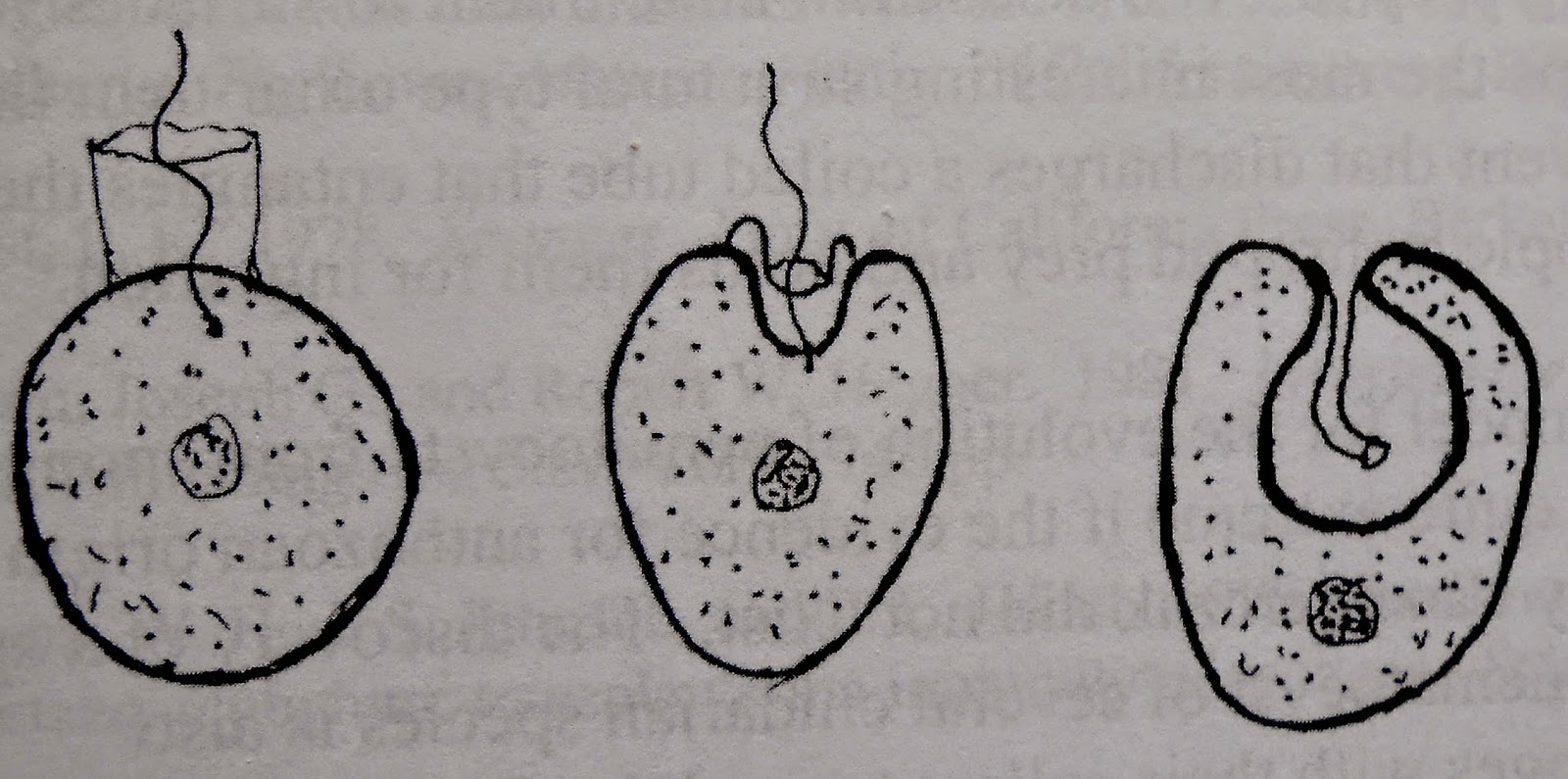
The observation that excited us was the presence of many free-swimming Stentor's taking on the shape typical of the mobile state.  There was a concentrated population and many had a large central enclosure, like the picture below shows in the upper Stentor, that encloses another Stentor.


Figure above.  Free-swimming Stentor with an enclosed Stentor.  

Some ciliates are known to reproduce by producing internal buds.  But it had never been reported for this protozoan.  So he was excited when he told me about it.  He had even dissected one to release the internal bud and when released it swam away.

Observing the process for a day or so we finally came to the awareness that it was not a bud.  It was another Stentor that had been swallowed whole.  Apparently, cannibalism occurs when food supply decreases in crowded populations.

The annelid theory

The annelid theory was popular a hundred years ago.  It may never have been universally accepted.  But it was as good as any competing theory of chordate ancestry at the time.  The clincher responsible for its rejection was the observation that developmental stages often are a great clue to relationships that are not evident in adult organisms.

The annelid theory had support for the correspondence of relationships of systems of annelids and inverted chordates, or vice versa.


Two Figures above.  Annelid/Vertebrate systems as illustrated in early 20th Century texts, the upper in Romer and the lower in Lull, with one inverted so you don't have to turn your monitor upside down.

The drastic change in embryology of annelids versus chordates was used to discredit the theory.  But the evidence I present of the probable role of pogonophorans in expediting the shift should be sufficient to reconsider the annelid theory.  Gould* presented a good assessment of why it should be reconsidered due to a better understanding of the limitations of the "biogenetic law".

In reviewing volume five of Hyman's The Invertebrates (1959, McGraw-Hill, New York), I found on page 224 the beginning statement on relationhips of pogonophorans read "It is not open to doubt that the Pogonophora belong to the Deuterostomia."  Later she says "the Pogonophora appear most closely related to the Hemichordata."  Earlier, on page 201, she said about the hemichordate-chordates, "Such identity is inconceivable except on the basis of a common ancestry.  Hence a phylogenetic relationship between hemichordates and chordates is not open to question."

Those comments were made before the evidence of relationship of pogonophorans to earlier polychaete annelids was discovered.

A bit about Libbie Henrietta Hyman

Libbie Henrietta Hyman was perhaps the most outstanding zoologist of the last century.  She produced a comparative anatomy manual used by many of the pre-med students of her era.  Then, in her position at the American Museum of Natural History in New York, she produced a multi-volume treatise on invertebrates that remains a remarkable resource.

In the final chapter of volume five discussing new developments of topics in earlier volumes she uses colorful language to express definite opinions.  For example on page 750 - "The author hoped that the enterocoel theory was dead and buried, as it deserves, but . . .".  Then "The author regards the enterocoel theory as fantastic nonsence, for which there does not exist a single scrap of genuine evidence."

She criticizes views putting Proterospongia in line with the origin of sponges.  She provides arguments that the anthozoans cannot be the earliest cnidarians.  Both of those views are contradicted in earlier posts of this blog.

She had command of a vast amount of biology of organisms so her opinions have had considerable influence.  She proposed putting several phyla in a natural grouping she named Aschelminthes.  It had some acceptance until some experts in some of the groups disagreed, perhaps they thought it minimized the importance of the groups they researched.  So she later abandoned the view although I think it was correct in the inclusion of most of the groups it included.

A lesson learned

The short life of many ideas and theories, changed because of varying emphasis on major or minor features, gives me pause when I think about my evolutionary ideas.  I have learned from the evidence to support the coalescence of the annelid theory as correct in the connection suggested, that gross features can be important.  They can also mislead, as the importance of radial versus bilateral symmetry did in forming major clusters of phyla; the transition either way among the two symmetries is eventually selected by the habit of being attached to a substrate versus having active movement over a surface.  So it is difficult to state unequivocally that some parameter is the ultimate measure of the direction of relationships.

*Gould, Stephen Jay.  2002.  The Structure of Evolutionary Theory.  The Belknap Press of Harvard University Press, Cambridge, Massachusetts.  1433 pp.

Joseph G. Engemann      March 2, 2015
Emeritus Professor of Biology, Western Michigan University

Friday, February 27, 2015

EVOLUTION: THE BODY CAVITY

BODY CAVITY, THE COELOM


The coelom has some very important functions that are seldom discussed in biology books and classes.

The coelom, the body cavity containing some organs, would seem like it is almost nothing.  But it is a nothing that is quite important in the evolution of animals.  When the space around the internal organs is filled with large cells having little to do other than filling up the space, the organism is said to be acoelomate, or lacking a body cavity.  When the same area is filled with fluid, the organism is said to be pseudocoelomate, or having a false body cavity.  Those animals that are coelomate, a designation meaning they have a true body cavity, may not have much fluid in the cavity.

The illustration of Nereis, above, shows the dorsal side opened above six of the parapodia (leg) bearing segments to show the coelom.  Nereis is an advanced polychete annelid, presumably more complicated than the ancestral one giving rise to the Pogonophora, but closer to the one giving rise to arthropods.

The evolutionary sequence was from acoelomate to pseudocoelomate to coelomate.  The difference between a pseudocoelomate and a coelomate animal is the absence or presence of a epithelial lining or peritoneum which is present in a coelomate animal and absent in a peudocoelomate animal.  The embryological origin of a true coelom varies.  If it develops from a split in cells of the mesoderm (the middle layer of cells in an embryo, it is said to be schizocoelous.  If it develops from outpocketing from the embryonic gut it is said to be enterocoelous.

IMPORTANT FUNCTIONS OF A COELOM


Isolation of organs for
physiological independence
          spatial independence when moving
                   minimal lubrication needed
          prevention of adhesions and
                   mouth formation and/or anastomoses
                   (a fundamental property of the underlying tissues
                 Of gut and blood vessels?)

Physiological independence is provided by the epithelium (peritoneum) covering the organs.  The covering provides a barrier to losing large molecules designed for function of the organ as well as preventing entry from those of other organs.  Thus the proper mix of chemicals needed for the specific role of the organ is not disrupted and/or is easier to maintain.  The barrier effect works because all coelomates have a circulatory system.  When a circulatory system is not present as in most pseudocoelomates the body cavity can provide many of its functions in supplying needed materials and removing wastes from the area for disposal by excretory and respiratory organs.

Spatial independence means the organs can reposition themselves without great distortion during movements.  For example, they don't get bent or squeezed so a gland is less likly to lose contol of providing its secretions appropriately.  The gentle activity they get from movements of the body is enough to help maintain normal function.  Activity is good for one's health if it is not too extreme.

The peritoneum covering the organs and lining the cavity are flattened cells making a smooth cover so that only a little moisture is needed for lubrication of movements.  Because the peritoneum is continuous from body wall to organ covering it forms a double layer or mesentary which provides two functions; it keeps the organs from getting twisted around or out of position and it can contain the blood vessels servicing the organ.  If an organ, such as kidney, is behind the peritoneum of the body wall, it  is said to be retroperitoneal in position; it then keeps its position better than if it were more flexibly located in a position just limited by its mesentaries. 

Prevention of adhesions is an important function because many tissues have the ability to fuse with other tissue if the peritoneum is not intact.  That is a property important in embryological development.  

The tissue of the primitive gut (the endoderm) of an embryo can fuse to the other layer (the ectoderm) and be the location of a mouth or an anus.  This property was important for the new location of the mouth to develop in pogonophoran ancestors as they moved into food-rich shallow seas and reform the digestive system as now seen in deuterostomes.

When the fusion and opening occurs as noted for the embryo it is fine.  But when surgical or other disruption of the peritoneum of adjacent organs occurs it can result in a new connection that is usually not wanted.  Such a structure connecting two parts of the digestive system is called a fistula. It may not be wanted, but is usually better than having an opening from the gut allowing contamination of the coelomic cavity, a typically fatal situation without rapid treatment.

Evolutionary considerations


The coelom was an effective way of solving some of the problems of increased body size.  Small organisms did not need special organs for overcoming the distance involved in moving all sorts of things used and produced by specialized organs.  Diffusion through fluids and tissues could take care of the problem.  But as size increased, direct diffusion was inadequate for moving things more than a few cells distance.  So to get adequate oxygen to tissues, some became flatter as they grew.  

Others (acoelomates) filled underlying spaces with jelly-like material that was nearly inert metabolically.  Others (pseudocoelomates) could get larger and have organs in the pseudocoel with enough fluid filling it to give them some escape from distortions with movement.  Also the fluid could move around and serve some of the transport role of a circulatory system.

Still other acoelomates had branches of the digestive system reaching to all regions of the body so movements of fluid in the gut could perform some of the vascular functions.  Hence, that type of development of the digestive system was called a gastro-vascular type of body cavity.

So coelom development was important when accompanying blood vascular system, respiratory, excretory, and endoskeletons needed for greatly increased size.  Of course there were other developments of importance.  One was the skin was no longer a single layer of cells or other simple covering; in the skin of vertebrates the epidermal layer is now serviced and supported by a dermal layer supplied with blood vessels and nerves.

When we talk about systems of the body, we seldom think of, or include, the coelom.  Too bad.

Four paragraphs back, I said "Others filled . . ."  -  is just a short way of saying "by the process of natural selection, survivors gradually, with the variants of the condition we are discussing, replaced the ancestral traits."

The views about the biology of the coelom expressed above are not based on experimental science in a direct way, but are more a view based on understanding of biological functions.  A quick survey of a small variety of texts (evolution, animal physiology, vertebrate biology, and an invertebrate reference on smaller coelomate phyla) provided no functional discussion.  The list under "important functions of a coelom" was in my journal notes for 10/03/06 that I read a few days ago and remembered talking to my classes about, in part, many years ago.  I don't remember the lectures or articles or books that may have inspired it.

Joseph G. Engemann     Emeritus Professor of Biological Science, Western Michigan University
Kalamazoo, Michigan    February 27, 2015 

Friday, February 20, 2015

MOLECULAR AND HUMAN EVOLUTION

Why today's comments?

I happened across an old personal journal entry from October 13, 2006 with the follow (slightly edited).

Kimura and Ohto 1961 on Molecular evolution is good for general principles, but the final page in particular need rebuttal about- 
assumption that verbal arguments based on evolutionary principles will become useless as computer approaches improve; and- 
presumption that neutral mutations are increasing at the same rate in “living fossils” as they are in others changing more rapidly. 
Aspects of human evolution thought about this morning (may be in the literature but) included: bipedal human ancestors were favored in surviving drying conditions at forest edge by ability to reach fruit on small branches better than others living in trees or as quadrupeds on ground.  Ancestors were also favored by being able to see other tree clumps across neighboring grasslands, and ability to see over grass to avoid predators or even frighten them by their erect posture providing an imposing frontal profile. Of course, views of Hamilton (Life’s Color Code) need to be included in discussion of human evolution.

The two rebuttal needing assumptions of the 1961 article cited were in error because (1) verbal arguments may be able to bridge a linear impasse a computer approach is incapable of evaluating.  And (2) neutral mutation rates would seldom increase at the same rate in "living fossils" as they are in other organisms.  (1) is shown by the failure of molecular phylogeny programs to compensate for generation time.  (2) is dramatically shown by the appearance of pogonophorans via "long-branch attraction" within computer generated trees of other groups.

Hamilton's book provides good evidence of how observation and reason can provide insightful understanding of human evolution. 

Numerous other posts of this blog provide support for the above rebuttals.  Although evolution may be used in labels with topics other than evolution, it is almost always used in labels for relevant evolution posts.  

Joseph G. Engemann      Kalamazoo, Michigan     February 20, 2015