Wednesday, June 4, 2014

A VICTORIAN ISOPOD

THE BIG SUBTERRANEAN ISOPOD

The largest terrestrial isopod that I know of is from the same suborder of the one I studied in Tasmania.  But it is much bigger and is adapted to life in shallow tunnels beneath the ferns, eucalyptus trees, and other vegetation of the cloud forest of the Ottway Mountains in Victoria, Australia.


I was trying to visit and collect specimens of the sub-order to which the isopod on Mount Wellington belongs.  Nicholl's monograph on the Phreatoicoidea indicated the type locality from which the species (Phreatoicopsis terricola) had been collected was about 20 miles from where I left a bus the take the road in the picture.  There was no public transportation along the road leading to Beech Forest where a small map on a postcard indicated a railroad existed.  Halfway to Beech Forest the map showed the town Olangalah.

Before reaching Olangalah I thought I would check to see if maybe isopods would be in the rainforest pictured above. When I got down a short distance into it and dug with a trowel I found tunnels immediately about an inch deep.  They were perhaps an inch or two in diameter and contained the isopods shown below.  I had to be careful to keep my distance from the abundant fern fronds, many of which had terrestrial leeches perched on the fern tips and ready to attach for a meal of my blood.


The isopods had a little yellowish pigmentation on the head.  The transparent body revealed a gut full of what I assumed was organic rich soil.  I put some in a jar without much water but adequate airspace and they survived the trip back to Tasmania.  But along the way I had some difficulties.  When I got back on the road and came to an opening with empty fields, I was sure it had been Olangalah, I was relieved I only had a few more miles to go before I got to Beech Forest.  I think maybe one car had gone past me before I thought I should try to hitch a ride.  A couple more went by the wrong way before I got to Beech Forest.  I found a hotel where I could get something to eat and asked about the train schedule to Melbourne where I had my ticket for a flight to Hobart the next day.

The only train was a weekly one that wasn't due for a few more days.  So I started hiking along the road to Melbourne.  It was dark when I passed the location by the Beech River where I had been hoping to collect the isopods.  Attempts to hitch-hike had been unproductive, I'm sure I wouldn't have picked up a hiker as disreputably looking as I was with boots and knapsack.  So I continued along the road winding up the mountain from the river valley.  In the wee hours of the morning I lay down along the road to rest, there had been no traffic for a long time.  I aroused with some hope as I heard a vehicle in the distance.  After what seemed like at least twenty minutes a large truck pulling a trailer with an enormous eucalyptus log approached and stopped.  When I asked if he could drop me of anywhere I could get transportation to Melbourne, he told me he was going to Melbourne.  Wow, what relief.

The big terrestrial isopods are quite small compared to the largest known isopods that are found at great depths in the ocean.  Shedd Aquarium in Chicago had some (Bathynomous gigas) on display the last time I was there.  The marine isopod is in the suborder containing the pillbugs, or sowbugs, and the aquatic isopods of the Northern Hemisphere.

Joseph G. Engemann        June 4, 2014

Monday, June 2, 2014

The Baleen Whale Tooth

THE WHALE'S TOOTH

In a previous post I thought I had referred to discovery of a tooth on a baleen whale's nose, but the posts on whales of last August and September did not have it.  So, at the risk of being repetitious, a whale that had washed up on a Tasmanian beach about six months before the pictures below were taken, in 1956 or 1957, was badly decomposed in the part exposed to the air.  The part deep in the salt-water laden sand still had fresh-looking red whale meat.  It had been identified as a Pygmy Right Whale.  We were there to get as much of the skeleton for the University of Tasmania's collections as my advisor (Dr. Guiler from the Zoology Department), another faculty member from the university, and myself could.


The ribs in the foreground were pulled from part of the carcass after the layer of skin or blubber (the brown layer that also had not decomposed) was moved.  As is evident the very gently sloping beach was perhaps a factor in the whale beaching itself.  It probably lacked a reflective surface to effectively return signals to the whale telling of the end of the ocean.  The skull is not obvious in the photo, but in the photo below you can see the part of the jaw with the tooth at the end is already quite weathered by exposure.


The tooth is of interest for several reasons.  It is certainly an indication the whale is derived from a toothed ancestor.  Its persistence suggests it has had some survival value in its ancestors and probable continuing value.  It may be of value in ramming an opponent.  The saga a few years ago of a whale in danger of being trapped in the Arctic Ocean as early winter ice was forming made me think it might be of use in fracturing the ice to enable breathing to support it for a longer under ice trip to open water or a new thin area to break.  It might suggest a relationship with narwhals and their long tusk.

If you read my posts on creativity you should realize we should at least consider the possibility that the tooth is a new development rather than a holdover from ancestors with tooth filled mouths.  I think the fossil record is adequate to dismiss such an idea and go on to other things.  One of those things might be the observation that marine mammals are thought to be the only placental mammals native to Australian shores and lands other than the bats prior to the arrival of humans.  So I will end with an example of a bat from Tasmania, circa 1957.


Joseph G. Engemann     June 2, 2014

Sunday, June 1, 2014

EVOLUTION: THE TASMANIAN ISOPOD

Mount Wellington, home of the isopod studied in Tasmania

Isopods are common marine, freshwater, and terrestrial animals with seven pairs of legs.  The one most familiar to you is probably the one that rolls up in a ball when disturbed after you pick up your flower pot.  Most are flattened so top and bottom appear close together.  But the one in Tasmania is part of an extremely old group and does not have that flattening, in fact it appears as though it is flattened with the sides closer together.

Mount Wellington is a little over 4,000 feet tall.  The summit is only a few miles from downtown Hobart, as shown from the harbor on the Derwent River below.  Darwin had difficulty reaching the summit, which he did late in the day on his second try.  It was much easier for me because a road had been built to very close to the summit.  The back side of the mountain still has tree ferns as noted by Darwin in his Voyage of the Beagle along the Northwest Bay River which is fed by the mountain top pools.


The isopods on Mount Wellington and others in the same suborder are now restricted to the Southern Hemisphere.  Although first discovered in well water in New Zealand, most species are found in Tasmania, with only three in South Africa.  Their discovery came after Darwin's visit to Tasmania and Mount Wellington where he may have trod through the pools where they are found as he gazed out from the summit and saw the views below.


What looks like moss covered rock is really the dense growth of branches of a composite noted below.


The pools around the round green composite Abrotenella fosteroides in the first picture closeup were sampled periodically for a year.


This view from just beyond the pool containing the isopods shows Ralph's Bay and the Tasman Peninsula to the East of the summit lookout.

At least a three year life cycle from egg to isopod to egg

All the isopods in one kitchen strainer scoop were collected, counted, and measured.  During the Australian summer they were inactive in the dried but damp pools.  When pools refilled in the spring, a new batch of young were released from the brood pouch (formed from plates extending from basal segments of four pair of legs) for the annual crop of young.  A maximum of 19 young or eggs were counted in pouches from other samples.


If you notice carefully you can see two or three age classes in the November sample. In the May sample only two of the young from the previous date were included as the new young became quite numerous.   A possible middle group from November is merging with the adults.  Relatively few adults were found in the July sample, although in August they were abundant.  Part of the disparity of adult numbers was probably due to the fact that many females with eggs were abundant under the green composite shown, while my samples came from the flocculent sediment in the deeper part of the pool.

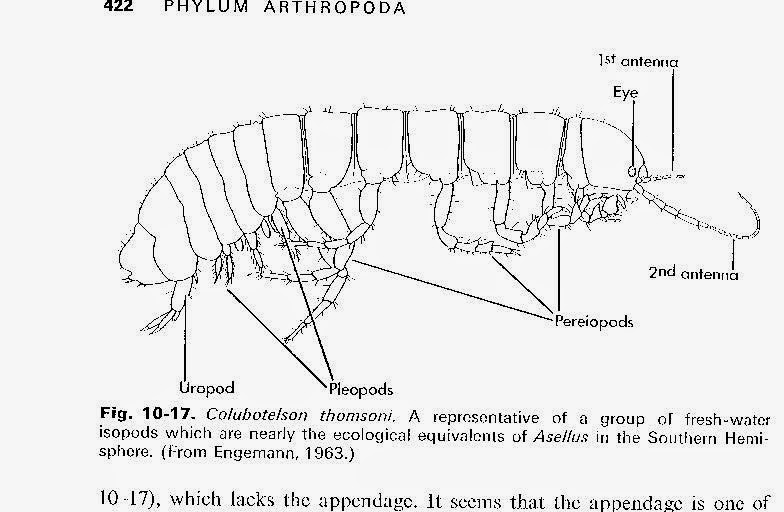
The pools were above the timber line on the mountain and had snow and ice part of the winter.  But it did not appear a factor in reducing the number of generations to one per year because a population of closely related isopods had the same growth pattern at sea-level on nearby Bruny Island.  Just for the record for interested zoologists, the isopod is Colubotelson thomsoni in the suborder Phreatoicoidea.  It is usually viewed from the side because the flattening make a specimen lay in that position as in the photo above and the figure below.


The pleopods beat in a channel made by downward projections of the sides of the abdominal plate.  They are the respiratory organs of the isopod, although in the male a portion of the second one is modified for sperm transfer.  This region of the abdomen retains the segmented nature whereas in the Michigan isopod (Asellus) the segments of the exoskeleton are fused.  Because of the flattening, its pleopods are exposed and the third one has a protective plate shielding the ones behind it.  The first two, unprotected are greatly reduced but the sperm transfer appendage of the male is still functional.  So both sexes have the respiratory function of the first two pleopods lost by selection driven by the selective value of the arrangement for the male.

The eggs of the Tasmanian isopod have about twice the diameter of the Michigan ones.  The egg shell is also about twice as thick.  Development to hatching takes several months in contrast to about two weeks for the Michigan one.  In a upcoming post I expect to show the egg appendage of the Michigan one which may help in its speedy development.

Joseph G. Engemann      June 1, 2014

Saturday, May 31, 2014

EVOLUTION INSIGHTS AUTHOR


The first missing picture intended to be posted with the first post on May 9 of last year (2013) is the picture below.


It was taken in 1957 in Colombo, Ceylon (now Sri Lanka) as I was returning from Australia.  The "snake charmer" said its fangs had been pulled so I wasn't too concerned about being bitten.  But back on the bus the driver said a lady had died from a bite from one a month earlier.  Then I remembered my herpetology professor, during work on my Master's degree at Michigan State University had told us about the fangs of snakes being replaced by others in waiting.


The anecdote may make you realize I shouldn't be taken too seriously, as I am, like most of us, prone to make mistakes and/or forget things.  Now, with my white hair and wrinkles, it doesn't bother me too much.

With all the "selfies" people are posting on their accounts, I thought maybe I would include one from about a year before the first one above.  It was in my lab in Hobart at the University of Tasmania with the Derwent River Estuary in the background.  I didn't need a fellow tourist to take it, I just used a self-timer with the camera.

It is not important to you, but I went through public schools in Ionia County, Michigan, before getting a B.A. at Aquinas College in Grand Rapids, Michigan; my major was Biology, my minor was English.  When I graduated in 1950 the Korean Was was soon to begin.  I delayed job hunting until a pre-induction physical would find me ineligible for service.  But they were desperate for bodies and I was fortunate to be sent to Germany, instead of Korea, following training at Camp Pickett in Virginia.  The year in Germany was accompanied by passes and leaves in which I visited about a dozen countries.  Many of my friends from basic training were sent as replacements to units in Korea.  The only one who contacted me after the war told me he and another buddy were wounded and another he heard of was killed.


The picture above is another self-timer one taken on maneuvers in Eastern Bavaria near the Czechoslovakian border.  It shows the tents of Clearing Company, part of the 118th Medical Battalion (the approximate equivalent of a MASH unit) of the 43rd Army Infantry Division.  I was discharged later that year (1952), too late to begin graduate school, got a job in a tool and die shop and liked the work so much I delayed return to school for over a year.

Most posts to follow this one will focus on the new points of evolution that I am trying to make understandable.  Previous posts lacked needed illustrations; and a few were too technical in hopes my colleagues would make the needed connections of how to correct current misunderstandings of evolution.

Joseph G. Engemann       May 31, 2014

Friday, May 30, 2014

LIVING FOSSILS

ANCIENT INVERTEBRATES?

Darwin, in his Voyage of the Beagle, laid out the theory about the formation of coral reefs, and atolls in particular, forming and only growing in shallow, warm, oceans but growing upward as land subsided or oceans rose.  His theory has largely been confirmed by evidence from boring deeply into Bikini and some other Pacific ocean coral islands.  Over a thousand feet of coral rock could be found in some locations.

I expected the growth represented generation after generation growing on top of the previous generation.  I thought some would get quite old by growing upward for a while, but I was surprised by the coral shown in the accompanying photo taken recently in the children's room of the Kalamazoo Public Library.


The photo shows skeletal part of a brain coral that appears to be growing from the middle of a similar coral underneath it.  I was  told it was donated by a local resident years ago after it had been collected in the Florida Keys region.

Below is a photo of a brain coral on the reef of Heron Island near the Southern end of the Great Barrier Reef.  The green wavy line next to it is the exposed mantle of a giant clam.


Corals and sponges are examples of invertebrates that could continuously grow upward as a reef sinks so that essentially the same organism remains near the surface for a very long time.  The first part and the last part would have the same genetic makeup, baring mutation, but would it still be the same individual.  It becomes a semantic problem to make a distinction.

So, what's the point?

The preceding is just an example of how organisms may almost suspend evolution.  As a result the long time between sexual generations means little chance for change as compared to most animals we know.  The one I have blogged about the most, the pogonophorans, happened to be the connecting ancestral group linking vertebrates to the protostomes.

Joseph G. Engemann        May 30, 2014

Saturday, May 17, 2014

FINDING GOD

STARING AT THE WALLPAPER

The kitchen of our second house had a busy wallpaper.  If memories of it forty years ago are correct, it had a yellowish background liberally adorned with smallish nondescript flowers and foliage.  But colors of pale flowers were predominate and smaller contrasting splotches of red and a few other colors were scattered in no obvious pattern.

Staring at the widely spaced red marks it soon became apparent that they were in a geometric arrangement, perhaps a foot apart, of vertical, horizontal and diagonal rows.  After a few months of repeating the observation, probably accompanied by coffee and cookie treats, I made what to me was a remarkable discovery.

In my amazement at how the red stood out, although it was the most vividly colored mark, I may have wondered if I could find other colors in the same pattern.  Because when I looked for blue, and subsequently green and other, color patterns, the red pattern disappeared.  Each color became my focus, however I desired, and became easy to see and all, not surprisingly, conformed to the patterns previously noted for the reds.

CONSCIOUS SEARCHES

The mind is a remarkable thing.  You don't have to do much other than think about what you want to find and you often soon find it if it is there.  If I have a word in mind I can often find it quickly on a page, a list, or a jumble.  Scanning lists of people's names, in alumni publications or other listings, can be done quite rapidly to find those you know without even thinking or looking for their particular name.

If the world is our wallpaper we can enjoy a trip through endless landscapes more enjoyably if we, like Darwin, learn to observe the rock formations, hills, streams, plants, and animals while looking for or noticing relationships of one to the others.

Searching people, friends and others, we can usually find what we are looking for in them, either good or bad.  A bad experience with them early tends to make us notice the bad.  Likewise, a good first experience tends to make us notice the good later.  The repetition can confirm the original view because we may have become blind to the other view.

FINDING GOD

God is not hiding.  Old Testament writers found him in a gentle breeze or a burning bush.  In the New Testament he variously appears as a dove, tongues of fire, and as Jesus Christ.  To us, God can be seen in his works, not as blotches on the wallpaper, but in everything good that he created.  For us, the challenge is to program our search engine to look for the good in everyone.  You can also look for one, eternal, all-powerful God's works at night when the light from the sun, reflected off the moon, took only a few minutes to reach us; the light from the nearest star, a year or so to reach us; and light from the farthest stars, uncountable years to reach us.

Alternatively, follow your conscience and as you become aware of the things God does for you, you will find God in your own experiences more convincing evidence than you could get from me telling you of my experiences.

Joseph G. Engemann      May 17, 2014

Monday, May 12, 2014

HELLO WORLD

Why "Hello World"

I just checked my blog settings and found I have been blogging about a year to myself.  Some brave souls managed to find it, especially in the last few months after a daughter started to comment on a few posts to friends on Facebook or Twitter.

The settings were so private that it was not listed on blogger and search engines could not see it.

What have you missed?

If your interest is evolution

- the post of May 31, 2013 has the basics of a major boo-boo made a few years earlier and perpetuated in errors supposedly showing the evolutionary relationships of animal phyla.

- read the blogs about annelids, the pogonophora, and why the annelid theory of chordate origin should be reinstated.  Perhaps start with post number four, 05/19/2013, on how cognitive dissonance entered in to my finding out why that is so.

- an efficient line of early evolution leading from protozoans to flatworms can be found in last July's posts.

If you are interested in the creation/evolution debate [in addition to the post of 07/10/15 just added]

- posts of 06/12/2013 and perhaps 03/12/2014 might be helpful.

- other posts may also help you see I think the debate is meaningless; God created the living world by a process we recognize as evolution.

Quirky and not so quirky views about God, Evolution, Creativity, Science, and other items are scattered through the posts.  They still do not have graphic illustrations.  Perhaps that deficiency will be taken care of sooner rather than later.

Joseph G. Engemann    May 12, 2014