More on Wilson's Creativity
In his interesting presentation of how the human brain and many aspects of social biology came about Wilson contends that "Natural selection as grand master of evolution means that humanity was not planned by any super-intelligence, nor was it guided by any destiny beyond the consequences of our own actions." [page 103 of E. O. Wilson, 2017, The Origins of Creativity, Liveright, New York.]
On page 6, he had said "Scientific explanations of organic life, including human life, routinely entail both proximate and ultimate causes." He contrasts that to the humanities attempting only proximate explanations and leaving ultimate cause to various entities, without much attention to the why of our existance.
On page 100 he says "Because of group selection, and its obvious consequences in the evolution of human social behavior, there is reason to suppose that the better angels of our nature need not be drilled into us under the threat of divine retribution, but are instead biologically inherited." He goes on to further recognize our amazing place in nature.
What Wilson Misses
God, as the Ultimate Cause, can take the chance events of natural selection, that we see as the operative principle of evolution, and use them to produce the remarkable human species. There are obvious bits and pieces of our evolutionary development based on various pre-human ancestors. But our disproportionately large brain has the capacity for performance well beyond what most of us achieve.
Wilson sees the humanities, language, and presumably the cumulative written record, as part of the cause of the gulf between us and the rest of the natural living world. He sees the good that results. I hope he comes to see that the good is God's results.
It is very difficult, for finite beings such as ourselves, not to underestimate the power, love, and majesty of the one infinite being, God. It is very much worth the effort to try to know God better. God already knows and loves each of us more than we do ourselves. It is awesome to consider the immensity of the universe and amazing diversity of life in a drop of pond water. I don't think God needs our input on how the world should be run. But we should make more effort for properly caring for our planet.
Joe Engemann Kalamazoo, Michigan February 1, 2017
Showing posts with label creativity. Show all posts
Showing posts with label creativity. Show all posts
Thursday, February 1, 2018
Wednesday, January 24, 2018
Evolution of Creativity
Edward O WILSON on CREATIVITY
Wilson is a remarkably
productive biologist. His intensive
early studies of ants helped him found the biological subdiscipline we call “sociobiology”
with a 1975 book by that name. But the
social behavior of ants is hard-wired into their small brains and not a particularly
good model for social behavior of humans.
In searching for the evolutionary roots of social behavior, ants and
humans diverged from their most recent common ancestor in the Pre-Cambrian, so
answers to our creativity are limited to very fundamental aspects. His book is fascinating and worth reading for
the spectacular grasp of related facts and opinions, especially the role of
language in creativity.
[Wilson, Edward O. 2017. The Origins of Creativity. Liveright Publishing Corporation. New York – London. A division of W.W. Norton & Co., New
York. 243 pp.]
On page 68 Wilson describes
his brief brush with Christianity and baptism.
Creativity seems to be tied to the humanities, especially language. On pages 75-77 he expresses concern that
organized religion siphons off funds that would be better spent supporting the
humanities. On page 194 he notes that “it
needs to be recognized, and talked about more frankly, that for philosophy the
elephant in the kitchen is organized religion.”
-because “the understanding of the human condition often foretold by the
blending of science and religion is inhibited by the intervention of
supernatural creation stories” of the separate tribes.
Dr. Wilson doesn’t have too
many years left to get back to that old-time religion that inspired him as a fourteen-year-old
about seventy-five years ago. Perhaps
this time he can apply his appreciation for the humanities to extract the good
from the stories and traditions of the monotheistic religions. It is not too late to develop a warm relationship
with Jesus.
Joe Engemann Kalamazoo, Michigan January 24, 2018
Sunday, October 29, 2017
LUTHER THEN AND NOW
Today's paper
A Washington Post article by Jonathan Kay,
“Nobody Listened to Luther at first. That’s why he succeeded”, published in the
Kalamazoo Gazette October 29, 2017,
deserves reading to see an example of how momentous ideas develop. Some similar circumstances surrounded Darwin’s
ideas about natural selection.
Non-conformists may face problems
Today such
factors as rapid communication and professional networks can, Kay writes, “make
us more cautious, since we know that any new idea can expose us to instant
censure from complete strangers in other parts of the world………. – This phenomenon
goes by different names – group think, political correctness, herd mentality. But in every form, it serves the interest of
the orthodox and frustrates the heretic.”
I sometimes
feel like I am a group of one in terms of my findings. I don’t expect to be in a group with Luther
or Darwin, but I am not aware of much acceptance of what I thought were my best
ideas about evolution. I do appreciate
the fact that my post about the coelom has received so many views.
An early
post of mine- http://evolutioninsights.blogspot.com/2014/02/creativity-brainstorming.html has had zero page views. The post makes
suggestions for solitary brainstorming that can substitute to some degree for
the benefits of group brainstorming.
Nematodes
I have begun
a draft of a post on nematodes. It is
hoped to be helpful in understanding the antiquity of their origin, far before
the time the erroneous Ecdysozoa implies.
I was reviewing some of Libbie Hyman’s invertebrate volumes and will leave
most related comments to the forthcoming post.
But the last two paragraphs of the post http://evolutioninsights.blogspot.com/2015/03/abandoned-theories-and-libbie-hyman.html said some of the things I might have repeated.
Christian Unity
Today, about
the 500th anniversary of the event most associate with Luther’s long
campaign, there is a mood that seems to have developed in recent years, of
Protestants recognizing that Catholics have gotten past such blemishes as
selling indulgences and killing heretics, and of Catholics thinking that
Protestants have selectively departed from teachings of Jesus. There is recognition of a common bond for
many on both sides of the former divide; and if it has not been there before, that
all humans are created by, and loved by, God.
Joseph Engemann Kalamazoo, Michigan October 29, 2017
Wednesday, August 2, 2017
SCIENCE: MEMORY
The July, 2017, issue of Scientific American cover featured an article on "Our Memories" by Alcino J. Silva about advances in learning and memory. His lab "had shown that the CREB gene was needed to form long-term memories. . . . . by encoding a protein that regulates expression of other genes needed for memory." The assignment of emotional memories as well as linking of memories are among things discussed.
The July-August, 2017, issue of AARP BULLETIN has a news item about an "electrical brain stimulation" research team, led by Michael Kahana, of "Neuroscientists at the University of Pennsylvania" who "have shown for the first time that stimulating the brain when it's foggy can significantly boost memory function. Conversely, stimulating the brain when it's sharp can impair thinking skills."
Panel discussions on TV news shows remind me of both stimulation and impairment when one persons comments stimulate another to interrupt and make it difficult for the first person to complete their statement clearly.
LINKED MEMORIES
Linked memories are undoubtedly part of the difficulties some veterans with post traumatic stress disorder experience, such as terror-filled memories triggered by loud noises. Emotionally charged memories may be linked with memories formed at the same time and may include visual, auditory, olfactory, and tactile stimuli that can later have a role in recollection of the associated memory.
Such linkage may be a factor in the use of mnemonics for remembering sequential or associated items. Since newly forming memories may be linked sequentially in a physical sequence in the brain, activation of one item in the list may aide recovery of others in the sequence. It isn't just harried mothers that use the name of the wrong child and then sometimes go through the list of all their kids before getting the right name. Anyone with an overloaded schedule is likely to do something similar without it being a mental defect.
A BIT ABOUT NERVOUS SYSTEM FUNCTION
The structure of the brain with memory and thinking intensive areas having several layers of neurons, with multiple fibers (dendrites and the axon with its branches) make it practically impossible to map or solve exact storage patterns. The tangle of fibers is only one part of the complexity. At the synapse, or gap at the junction of a fiber with the next neuron, the impulse (depolarization wave) results in the release of a neurotransmitter. There are neurotransmitters with various functions, some that stimulate, some that inhibit, and others with a range of speed of action or persistence.
The neurotransmitter at the neuro-muscular junction is typically acetyl choline. It causes the muscle cell membrane to send a depolarization wave along its length, causing contraction of the muscle. Choline esterase is an enzyme in the gap that breaks down the acetyl choline allowing its constituents to be recycled into acetyl choline in the original fiber. Because neuro-muscular junctions of other animals use the same process some of the most rapid acting insecticides are choline esterase inhibitors. Our large size makes it more likely to kill insects before the concentration we are exposed to kills us. I had a student who would come back for the Fall Semester, after working fogging for mosquito control in Northern Michigan resorts most of the summer, with obvious twitchiness. He survived it and was an effective biology teacher for many years.
MEMORIES, LIES, HONESTY, AND CREATIVITY
I have made the point in an earlier post that honesty is beneficial in developing creativity of a beneficial sort. It may be that a liar has more linked memories on a topic, perhaps half of them untrue. Does it then become impossible for them to distinguish truth from fiction? An hour or so ago a panel on CNN was discussing our president's blend of fact and fiction had an early expression in his noting his marvelous home run to his classmate who reminded him it was just a single. Apparently he was oblivious to the fact and repeated his recollection of his magnificent home run.
Scientists try to be honest and truthful in their work. But complications due to complexity and sometimes relying on opinions of leading scientists, who have unintentionally given erroneous views credibility, can perpetuate and increase errors. My early evolution blogs focused on one particular instance in the calculation of the ancestral tree of animals in which the pogonophora should be recognized as a remarkable link.
IMPROVING MEMORY AND OR RECALL
for memory
Learn a bunch of connected things in uninterrupted fashion.
Multi-tasking is an interruption.
Its all important.
Repetition may help, especially if your mind wandered.
for recall
Activate the appropriate regions of the brain by thinking about related things, locations, functions, people, times.
Be rested, fed, happy and comfortable or relaxed (don't be bothered if it doesn't come immediately)
long-term preparation
Read, listen to music, play games, socialize, exercise, eat a balanced diet, sleep, meditate, appreciate nature and the world around you, and it certainly wouldn't hurt to pray, love God, your neighbors, and yourself.
Joe Engemann Kalamazoo, Michigan August 2, 2017
The July-August, 2017, issue of AARP BULLETIN has a news item about an "electrical brain stimulation" research team, led by Michael Kahana, of "Neuroscientists at the University of Pennsylvania" who "have shown for the first time that stimulating the brain when it's foggy can significantly boost memory function. Conversely, stimulating the brain when it's sharp can impair thinking skills."
Panel discussions on TV news shows remind me of both stimulation and impairment when one persons comments stimulate another to interrupt and make it difficult for the first person to complete their statement clearly.
LINKED MEMORIES
Linked memories are undoubtedly part of the difficulties some veterans with post traumatic stress disorder experience, such as terror-filled memories triggered by loud noises. Emotionally charged memories may be linked with memories formed at the same time and may include visual, auditory, olfactory, and tactile stimuli that can later have a role in recollection of the associated memory.
Such linkage may be a factor in the use of mnemonics for remembering sequential or associated items. Since newly forming memories may be linked sequentially in a physical sequence in the brain, activation of one item in the list may aide recovery of others in the sequence. It isn't just harried mothers that use the name of the wrong child and then sometimes go through the list of all their kids before getting the right name. Anyone with an overloaded schedule is likely to do something similar without it being a mental defect.
A BIT ABOUT NERVOUS SYSTEM FUNCTION
The structure of the brain with memory and thinking intensive areas having several layers of neurons, with multiple fibers (dendrites and the axon with its branches) make it practically impossible to map or solve exact storage patterns. The tangle of fibers is only one part of the complexity. At the synapse, or gap at the junction of a fiber with the next neuron, the impulse (depolarization wave) results in the release of a neurotransmitter. There are neurotransmitters with various functions, some that stimulate, some that inhibit, and others with a range of speed of action or persistence.
The neurotransmitter at the neuro-muscular junction is typically acetyl choline. It causes the muscle cell membrane to send a depolarization wave along its length, causing contraction of the muscle. Choline esterase is an enzyme in the gap that breaks down the acetyl choline allowing its constituents to be recycled into acetyl choline in the original fiber. Because neuro-muscular junctions of other animals use the same process some of the most rapid acting insecticides are choline esterase inhibitors. Our large size makes it more likely to kill insects before the concentration we are exposed to kills us. I had a student who would come back for the Fall Semester, after working fogging for mosquito control in Northern Michigan resorts most of the summer, with obvious twitchiness. He survived it and was an effective biology teacher for many years.
MEMORIES, LIES, HONESTY, AND CREATIVITY
I have made the point in an earlier post that honesty is beneficial in developing creativity of a beneficial sort. It may be that a liar has more linked memories on a topic, perhaps half of them untrue. Does it then become impossible for them to distinguish truth from fiction? An hour or so ago a panel on CNN was discussing our president's blend of fact and fiction had an early expression in his noting his marvelous home run to his classmate who reminded him it was just a single. Apparently he was oblivious to the fact and repeated his recollection of his magnificent home run.
Scientists try to be honest and truthful in their work. But complications due to complexity and sometimes relying on opinions of leading scientists, who have unintentionally given erroneous views credibility, can perpetuate and increase errors. My early evolution blogs focused on one particular instance in the calculation of the ancestral tree of animals in which the pogonophora should be recognized as a remarkable link.
IMPROVING MEMORY AND OR RECALL
for memory
Learn a bunch of connected things in uninterrupted fashion.
Multi-tasking is an interruption.
Its all important.
Repetition may help, especially if your mind wandered.
for recall
Activate the appropriate regions of the brain by thinking about related things, locations, functions, people, times.
Be rested, fed, happy and comfortable or relaxed (don't be bothered if it doesn't come immediately)
long-term preparation
Read, listen to music, play games, socialize, exercise, eat a balanced diet, sleep, meditate, appreciate nature and the world around you, and it certainly wouldn't hurt to pray, love God, your neighbors, and yourself.
Joe Engemann Kalamazoo, Michigan August 2, 2017
Sunday, May 24, 2015
CREATIVITY posts list
The 17 blog posts [ on evolutioninsights.blogspot.com/ ] listed below have something to do with creativity. The ones with creativity in the title are somewhat more likely to have something of benefit in helping develop and/or understand creativity. The number is from the sequential list of over 100 posts; the date can be used to help you access the blog from the blog archive on the right.
1 5/9/2013 My
Evolution Blog
3 5/18/2013 Creativity
4 5/19/2013 Creativity and Cognitive Dissonance
31 11/11/2013 Creativity: honesty helps
34 2/2/2014 Science: Quiet and Creativity
35 2/8/2014 Creativity: Art
36 2/18/2014 Creativity: Brainstorming
37 2/28/2014 Science Thinking Errors
40 3/12/2014 Evolution Insights: Preface
47 5/4/2014 Psychoanalysis of a blogger
52 5/31/2014 Evolution Insights author
61 7/25/2014 Evolution: Intelligence and Creativity
65 8/18/2014 Creativity: Last First
70 10/5/2014 Creativity: Reverse Viewing
71 10/11/2014 Habit, Creativity, Evolution, and God
77 11/19/2014 Creativity: Frame of Mind
92 2/8/2015 Creativity, bee language, and
dyslexia
Joseph G. Engemann May 24, 2015
Sunday, February 8, 2015
Creativity, Bee Language and Dyslexia
CREATIVITY
There are so many factors that determine creativity it is doubtful that we could ever make a routine that would consistently develop geniuses. Creativity is not a single attribute signifying greatness in a field of interest. Is it determined by number of successes? Is it determined by skill or novelty? Is it determined by I.Q. or genius? I think creativity is a subjective attribute of a person and cannot be measured with scientific accuracy nor other objective measure. Perhaps it is one thing that might be measured better than most things can be- with a popularity poll.
IQ and GENIUS
High intelligence quotients and genius are typically viewed in popular usage as synonyms or very similar, if not identical, superior mentalities. This may be evident in a current TV program, Child Genius, in which astounding feats of memory seem to be a major measure of genius in the competition. I do not think genius nor creativity are measured by speed of recall ability nor size of a set of facts. Perhaps it is my own bias that thinks so because I am a mental plodder compared to many bright people, and, with age, the certainty of remembering something during a conversation is increasingly remote.
I.Q. has memory efficiency as a major component. Breadth of knowledge is another major component. Both can be measured with a suitable test that typically combines both components. Ability to apply those mental skills is less easily measured accurately. The general public, with some justification tends to label those in academia as being disconnected with the practical world and in an "ivory tower". They also frequently apply the label "lacking common sense" to those in and outside of academia that proclaim themselves geniuses.
LANGUAGE OF BEES
Bees have the ability to communicate with other bees, but it is more of a monologue than a dialogue such as we think is important in conversation. The bee language was largely determined in its major aspects by Karl von Frisch many years ago. Refinements have been found more recently. The basic facts discovered by von Frisch were transfer of food substances for tasting to identify the foods to be sought, and dances that help the other bees find the sources of those foods.
Distance was communicated by a circular dance indicating it was near the hive so "go and find it". Direction was communicated by a waggle dance on the face of the honeycomb with the direction angle relative to the sun being the straight up direction. Distance in the waggle dance was proportional to the length of the waggle dance.
The first information, the food, was the first thing conveyed by the sample. The last information was the direction and distance with the dance. The amount of honey the workers consumed before departing on the foraging trip was determined by the distance. Perhaps the amount was also determined automatically by feeding proportional to the flight distance communicated by the length of the dance. The order of the information flow may be seen in the following section.
DYSLEXIA
Last in, first out, may indicate a basic mental process as old as the bee language. When letters come out in reverse order when we are dyslexic, it results in written language difficulties for a dyslexic. But their brains are commonly thought to function at a higher than average level in other respects - perhaps even at the level of genius. I don't know how many numerals of a large number could be recited backwards by a dyslexic, but I bet it would be many more than a non-dyslexic could do.
I've always wondered if I, as a child, was borderline dyslexic with the difficulty I had in distinguishing right from left. The distinction could be in directions communicated or printing a capital N, Z and some other letters in reverse orientation.
The elements of switching order of things can come out as a "spoonerism" when switching initial letters of words in a two word phrase gives new words with a different meaning. I'm surprised I didn't name the post of a week or so ago Ting Kut, instead of King Tut.
PIG LATIN
Pig Latin is a slightly more complicated transposition of word elements than in a spoonerism. My brother was very proficient at it but I was quite slow in my processing of it. Talking it was widespread fun for kids eighty years ago. It had some use in World War II for communicating, perhaps with captive GI's, to keep their captors from knowing what they were saying.
Before "Pig Latin" dies as a language the basis for it as I remember it was- merely switching order of the first and the last part of each word, then adding something like -a, ay, or -eh. It really garbles it up for those not having high proficiency with the English Language.
MEMORY
If the ancient process of storing and retrieving information in the nervous system began with a simple process, probably well before bees evolved (our closest common ancestor with bees was an annelid worm), then it is not surprising that there are elements of memory principles that are basic to our mental functions. I sat down a little after noon to write this post less than an hour after thinking of it, mostly as I was showering. I left the Sunday paper, that is one of my favorite weekly reading chores, to write this- now about two hours post shower. I did it so quickly because remembering connections of thoughts diminishes rapidly with time and I soon have a difficult time seeing why what I thought was important really was. The measure is better determined at a later time. It would be best to wait a year or so, but I will probably settle for an hour or two (or after I've read the paper, especially the comics).
Joseph G. Engemann Kalamazoo, Michigan February 8, 2015, 2:29 PM EST
Final proof-reading question: What is "igpay atinlay"?
There are so many factors that determine creativity it is doubtful that we could ever make a routine that would consistently develop geniuses. Creativity is not a single attribute signifying greatness in a field of interest. Is it determined by number of successes? Is it determined by skill or novelty? Is it determined by I.Q. or genius? I think creativity is a subjective attribute of a person and cannot be measured with scientific accuracy nor other objective measure. Perhaps it is one thing that might be measured better than most things can be- with a popularity poll.
IQ and GENIUS
High intelligence quotients and genius are typically viewed in popular usage as synonyms or very similar, if not identical, superior mentalities. This may be evident in a current TV program, Child Genius, in which astounding feats of memory seem to be a major measure of genius in the competition. I do not think genius nor creativity are measured by speed of recall ability nor size of a set of facts. Perhaps it is my own bias that thinks so because I am a mental plodder compared to many bright people, and, with age, the certainty of remembering something during a conversation is increasingly remote.
I.Q. has memory efficiency as a major component. Breadth of knowledge is another major component. Both can be measured with a suitable test that typically combines both components. Ability to apply those mental skills is less easily measured accurately. The general public, with some justification tends to label those in academia as being disconnected with the practical world and in an "ivory tower". They also frequently apply the label "lacking common sense" to those in and outside of academia that proclaim themselves geniuses.
LANGUAGE OF BEES
Bees have the ability to communicate with other bees, but it is more of a monologue than a dialogue such as we think is important in conversation. The bee language was largely determined in its major aspects by Karl von Frisch many years ago. Refinements have been found more recently. The basic facts discovered by von Frisch were transfer of food substances for tasting to identify the foods to be sought, and dances that help the other bees find the sources of those foods.
Distance was communicated by a circular dance indicating it was near the hive so "go and find it". Direction was communicated by a waggle dance on the face of the honeycomb with the direction angle relative to the sun being the straight up direction. Distance in the waggle dance was proportional to the length of the waggle dance.
The first information, the food, was the first thing conveyed by the sample. The last information was the direction and distance with the dance. The amount of honey the workers consumed before departing on the foraging trip was determined by the distance. Perhaps the amount was also determined automatically by feeding proportional to the flight distance communicated by the length of the dance. The order of the information flow may be seen in the following section.
DYSLEXIA
Last in, first out, may indicate a basic mental process as old as the bee language. When letters come out in reverse order when we are dyslexic, it results in written language difficulties for a dyslexic. But their brains are commonly thought to function at a higher than average level in other respects - perhaps even at the level of genius. I don't know how many numerals of a large number could be recited backwards by a dyslexic, but I bet it would be many more than a non-dyslexic could do.
I've always wondered if I, as a child, was borderline dyslexic with the difficulty I had in distinguishing right from left. The distinction could be in directions communicated or printing a capital N, Z and some other letters in reverse orientation.
The elements of switching order of things can come out as a "spoonerism" when switching initial letters of words in a two word phrase gives new words with a different meaning. I'm surprised I didn't name the post of a week or so ago Ting Kut, instead of King Tut.
PIG LATIN
Pig Latin is a slightly more complicated transposition of word elements than in a spoonerism. My brother was very proficient at it but I was quite slow in my processing of it. Talking it was widespread fun for kids eighty years ago. It had some use in World War II for communicating, perhaps with captive GI's, to keep their captors from knowing what they were saying.
Before "Pig Latin" dies as a language the basis for it as I remember it was- merely switching order of the first and the last part of each word, then adding something like -a, ay, or -eh. It really garbles it up for those not having high proficiency with the English Language.
MEMORY
If the ancient process of storing and retrieving information in the nervous system began with a simple process, probably well before bees evolved (our closest common ancestor with bees was an annelid worm), then it is not surprising that there are elements of memory principles that are basic to our mental functions. I sat down a little after noon to write this post less than an hour after thinking of it, mostly as I was showering. I left the Sunday paper, that is one of my favorite weekly reading chores, to write this- now about two hours post shower. I did it so quickly because remembering connections of thoughts diminishes rapidly with time and I soon have a difficult time seeing why what I thought was important really was. The measure is better determined at a later time. It would be best to wait a year or so, but I will probably settle for an hour or two (or after I've read the paper, especially the comics).
Joseph G. Engemann Kalamazoo, Michigan February 8, 2015, 2:29 PM EST
Final proof-reading question: What is "igpay atinlay"?
Wednesday, November 19, 2014
CREATIVITY: FRAME OF MIND
Preparation for creativity
A dilemma is presented by the broad and deep background that is desirable for creativity - it can be an impediment to an unbiased view and preoccupy us with thinking that has not produced a solution. "A fresh approach is then more difficult than it would be for an intelligent, ignorant neophyte."
If you come up with a good idea without having studied the subject intensively, you won't know whether it has been done before or if some evidence exists showing it is impractical. A second approach can be useful to both expert and neophyte, the development of a questioning attitude.
Questioning attitude
"A questioning attitude must be balanced with a confidence in the existence of solutions, answers, and causality. Rather than let knowledge of an uncertainty principle escape its bound of valid application and erode our confidence in areas it has no application, we should focus on the universal relationship of cause and effect. For every question, there is an answer, if only that the question is nonsense. A questioning attitude can dampen the free flow of ideas. Negative expressions are wisely excluded from group brainstorming sessions in the initial proposal developing stage. Realistic evaluation comes later."
So, a questioning attitude, keep it reasonable. The following cartoon may apply.
 The caption says "Have you noticed how he never seems to agree when you say 'nice day'"
"Our minds can become channelized by factors other than the knowledge of literature and accomplishments in the subject. Just as we use repetition to learn and fix things in our mind, repetition will make the implausible seem axiomatic. This is a special danger to those ignorant of the the subject and in the favorable position of viewing it freshly. The first idea, unless readily disproved, has the greatest chance of being repeated. Succeeding ones have progressively less chance of taking the favored position. Perhaps some people cherish their own idea because it is their only one."
The cartoon below speaks to the subject.
 The caption says "Tell me it's not cancer doc, I've been worried ever since I got this persistent pain in my posterior."
"It is worth attempting a little self analysis to determine our personal quirks so we can compensate for them. Do we reject the new? Do we overvalue and revere the new experience just because it is new? Is the old outmoded? Is the old the proven best? Do we delight in complexity, or simplicity? Can we answer always to any of the preceding? If so we may have a built in bias toward or away from some ideas. The hypochondriac, those with special fears, and those with special love do. Don't we all?"
Honesty
"Honesty is essential to the maintenance of creativity. Honesty with others will reduce self-deception. Honesty does not mean that everything known must be used or told."
The cartoon for this subject follows.
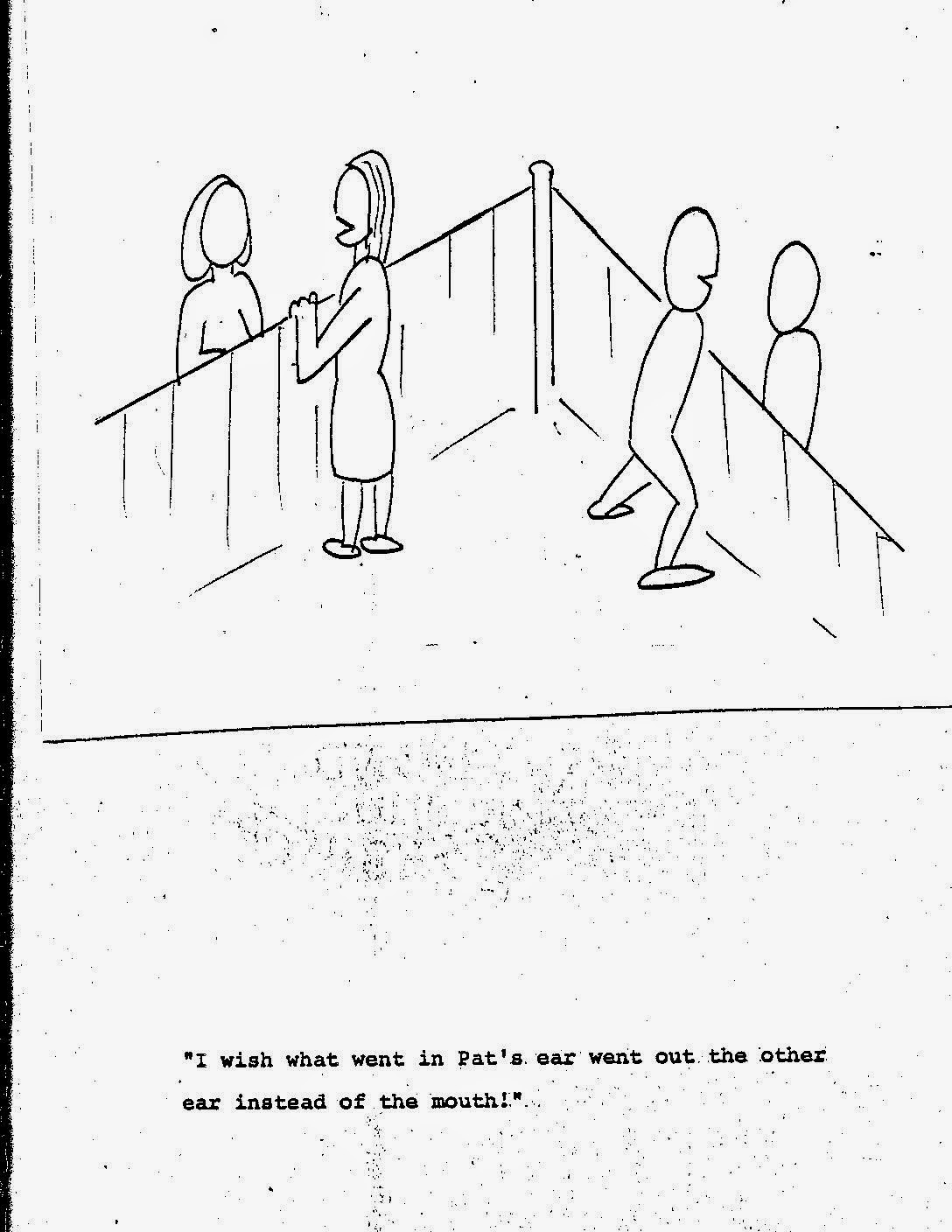 The caption says "I wish what went in Pat's ear went out the other ear instead of the mouth!"
Quotes and cartoons are from Chapter 4 of my unpublished 1974 manuscript, "The Two Way Street: One Approach to Creativity"
Joseph G. Engemann Kalamazoo, Michigan November 19, 2014
A dilemma is presented by the broad and deep background that is desirable for creativity - it can be an impediment to an unbiased view and preoccupy us with thinking that has not produced a solution. "A fresh approach is then more difficult than it would be for an intelligent, ignorant neophyte."
If you come up with a good idea without having studied the subject intensively, you won't know whether it has been done before or if some evidence exists showing it is impractical. A second approach can be useful to both expert and neophyte, the development of a questioning attitude.
Questioning attitude
"A questioning attitude must be balanced with a confidence in the existence of solutions, answers, and causality. Rather than let knowledge of an uncertainty principle escape its bound of valid application and erode our confidence in areas it has no application, we should focus on the universal relationship of cause and effect. For every question, there is an answer, if only that the question is nonsense. A questioning attitude can dampen the free flow of ideas. Negative expressions are wisely excluded from group brainstorming sessions in the initial proposal developing stage. Realistic evaluation comes later."
So, a questioning attitude, keep it reasonable. The following cartoon may apply.
"Our minds can become channelized by factors other than the knowledge of literature and accomplishments in the subject. Just as we use repetition to learn and fix things in our mind, repetition will make the implausible seem axiomatic. This is a special danger to those ignorant of the the subject and in the favorable position of viewing it freshly. The first idea, unless readily disproved, has the greatest chance of being repeated. Succeeding ones have progressively less chance of taking the favored position. Perhaps some people cherish their own idea because it is their only one."
The cartoon below speaks to the subject.
"It is worth attempting a little self analysis to determine our personal quirks so we can compensate for them. Do we reject the new? Do we overvalue and revere the new experience just because it is new? Is the old outmoded? Is the old the proven best? Do we delight in complexity, or simplicity? Can we answer always to any of the preceding? If so we may have a built in bias toward or away from some ideas. The hypochondriac, those with special fears, and those with special love do. Don't we all?"
Honesty
"Honesty is essential to the maintenance of creativity. Honesty with others will reduce self-deception. Honesty does not mean that everything known must be used or told."
The cartoon for this subject follows.
Quotes and cartoons are from Chapter 4 of my unpublished 1974 manuscript, "The Two Way Street: One Approach to Creativity"
Joseph G. Engemann Kalamazoo, Michigan November 19, 2014
Saturday, October 11, 2014
HABIT
HABIT, CREATIVITY, EVOLUTION, AND GOD
Habits may seem like worthless attributes, but they are important in the way we function. Sometimes they are beneficial in accomplishing routine tasks; at other times they can lead us astray at critical decision-making times. Today, one provoked thoughts, of many aspects of their influences on us, while I was showering.
My habit upon arising soon moves into shaving, brushing my teeth, then showering. Often, as today, I was still a little foggy from just awakening. Reaching for the toothpaste, I reached for the tube that was nearly depleted of toothpaste. Fortunately, I realized it was a skin ointment before I had squeezed any on to my toothbrush. And it provoked the thoughts related to habit, creativity, evolution, and God.
HABIT
I do a lot of thinking in the shower. The tasks of showering have become a nearly mindless routine. Other physical tasks are put aside. Conversation, reading, eating, TV, phone are impractical while showering. So one is left with thinking as one of the few activities conveniently accompanying showering. Unfortunately, thinking sometimes interferes with accomplishing the shower efficiently; for this reason it can be an ecological error wasting hot water although the time may be well spent if thoughts are productive.
The delay made me even later than I had planned to be for my youngest grandchild's final soccer game of the season. The role of habit is enshrined in the aphorism "we are creatures of habit".
In sports and many other activities, we take advantage of habits by promoting them in an activity we call "practice". The value there is three-fold. Practice exercises and helps develop the muscles involved in the various movements of the practice. Practice presumably enhances the performance of the nerve and synapse pathways used in the activity. Those activities of the pathways may be induced by a simple stimulation of one neuron rather than the multitude of ones needed to be incorporated during the laborious learning period.
Many neural pathways are a result of normal development. One of the more simple types is the knee jerk reflex when the patellar tendon is tapped causing lower leg extension without brain involvement (just a reflex arc involving at least a sensory neuron, an association neuron in the spinal cord, and a motor neuron) producing the muscular action.
EVOLUTION
Habits can be learned. As noted in the previous section they can be beneficial. Natural selection can result in improvement of animal features that enhance survival and reproduction. Some consequences of such a selective line could be increased size of the nervous system, and thus possible adaptive variety in neural pathways. Also increased/decreased size toward optimal size can evolve.
Aping
The natural tendency to mimic is seen in other primates as well as ourselves. It certainly had a beneficial role in survival of ancestors. One offshoot of aping is follow-the-leader. It enabled activities and movements to be passed on from generation to generation before written and/or spoken language were available. Would agriculture or migratory paths of nomads have been established without this tendency?
Sometimes negative habits of this type can be result from peer-pressure, like armies so dedicated to the leadership that they easily(?) do horrible things. Or a dislike of broccoli may be produced by an inappropriately timed grimace on a parental face. The same phenomenon may have saved countless ancestors from ingesting poisonous foods.
Instinct
Evolution via natural selection can help incorporate behavioral features that are hard-wired and/or enhanced by experience. One well known example is the imprinting shown by geese studied by Lorenz. The first large moving object they encountered after hatching was treated by the baby geese as mother goose. If they saw Lorenz first, they followed him as goslings normally follow their mother.
Evolutionary steps of behavioral attributes
Behavioral attributes are probably at least as slow to evolve as are physical attributes. One reason is that physical attributes are continuously exhibited in contrast to the occasional employment of a behavioral attribute. I saw this with surprise when I heard a robin outside the laboratory when I was at the University of Tasmania. I went to the door and saw an all black bird, robin sized, but without the familiar red breast of the North American robin. Its tail flicks, hopping, and cocking its head to find a worm were identical to my experience with the robins at home.
Turdus turdus, the robin first described by Linnaeus is the one in Tasmania, was remarkably like Turdus migratoria, the North American robin. They presumably had been separated from their common ancestor by several millions of years, yet behavioral/instinctive/learned(?) attributes were still intact.
Insects are remarkably complex in the range of behaviors exhibited by different species. Many of their instinctive behaviors are most certainly a product of variant selection in development of the nervous system.
Some related species may keep similar reproductive behavior connected with changing pheromones as species evolve. Some closely related moths respond to a blend of sex attractant chemical only slightly different in proportions than those of close relatives. They may function, for example, as intermediate stages leading to completely different sex attractants in other lines of different species.
Speciation
Insect behavioral changes may go hand in hand with changes leading to new species if the behavior leads them consistently to different locations or extremes of reproductive behavioral traits. Some time physical changes lead to physical incompatibility of reproductive structures comprising the "lock and key" genitalia of female and male individuals. Once temporal, geographic, behavioral, or physical changes produce reproductive isolation, speciation can occur.
CREATIVITY
One might think that habits were enemies of creativity. When creativity represents change competing with the status quo our social systems tending to favor it can reduce creativity to some extent. But developing behaviors or mental functions compatible with creative activity should benefit creativity. These aspects may be found in some past, and probably some future, posts.
GOD
Habits have a role in our relationship with God that can be good, bad, or of little importance. The topic deserves more extensive treatment in a later post. It may be good to have a habit of prayer, but don't be so hide bound by it that you do not react and rescue the little child in the path of the approaching train. Or, don't be so charitable giving away your money if your family desperately needs it for food, shelter, or clothing.
Joseph G. Engemann October 11, 2014
Monday, October 6, 2014
CREATIVITY
Reverse Viewing
THE TWO WAY STREET
My creativity manuscript, The Two Way Street, Chapter Five, begins with the sentence - "Seeing things from more than a single point of view is the fuel for creativity." "There is no such thing as a one-way street; it is only usage that makes it so. If there is no requirement that there be only one solution possible to a problem, there is no inherent logic that limits the possible solutions to two or more."
EVOLUTION
The answers to evolutionary questions have often been short-circuited by buying current fads and not looking for alternative solutions. The fad may have some value in partial solutions, but can obstruct a view giving a more complete or accurate answer if we buy it as the total answer. For example, catastrophism and inheritance of acquired characteristics were early views of little value beyond the historical aspect. Embryological similarities and current limited DNA studies are of partial value but inadequate as currently applied in major phyla relationships. A major focus of many other posts on this blog is presenting evidence to help straighten out the current mess in the view of higher phylum relationships.
PARTIAL TRUTHS
I am not immune to making errors, some basic ones, as well as some simple typos. Misapplication of the theme of this post and my fallibility is the theme of the cartoon below from chapter five.

The final paragraph of the chapter
"This point is the essence of creativity, looking actively for another answer. Examining all points of view; submerging our inherent self-centeredness to see answers emerging from other points; proceeding in other directions; such an approach with people can improve our relationships, the happiness of all concerned, and increase our creative potential. It is the beginning of understanding and rapport to look for the other person's point of view. If you have not done that but begin to do it, do not be discouraged if your action is not reciprocated. Remember how long it took us to reach that point. We must retain our breadth of view in all areas if we are not to let a self-limiting, self-serving view encroach on our creative potential."
[The quoted portions above were written in the early 1970's, about ten years before I had the "eureka" event seeing how the pogonophorans were the major link that had been missing for understanding the origin of deuterostomes from protostomes.]
CREATIVE ATTITUDES
Reverse viewing is one of several metal habits that can be useful in becoming more creative. A questioning attitude, with a willingness to accept what we question if it is supported by the facts, is another way to break free from the "status quo" resistance to change common to our thinking. Most change is bad in a well-designed system. The chromosomal repair mechanism has evolved and generally does what's best. But in our own thinking we need to evaluate proposed changes, as well as what is presently the case, in order to progress to an improved solution. Look for what makes a seemingly erroneous view be endorsed by others.
So question, evaluate, search for solutions, be interested in the world around you, be humble, and be on your way to being creative. Be convinced that there are causes for everything; it is easier to believe so and more convincing if you believe in an Ultimate Cause; it impedes looking for an answer if you think there may not be one. Time is on your side.
Joseph G. Engemann Kalamazoo, Michigan October 6, 2014
Saturday, October 4, 2014
EVOLUTION, SCIENCE AND EXTRATERRESTRIAL LIFE
Evolution, Science, and Extraterrestrial Life
EXTRATERRESTRIAL LIFE
The search for extraterrestrial life was featured in a NOVA, or some other, television program I happened across yesterday. Over the years I have come to the conclusion that there are people on countless other planets in the universe, but that documenting or proving it is impossible. Still, it is worth considering the arguments and evidence that might convince us of the existence of someone with a potential to communicate with us from some far galaxy.
SCIENCE
The most hopeful search described on television was an attempt to detect radio-wave transmissions from outer space via a reception on a radio-telescope array. Radio-waves are presumably subject to no, or less, distortion as they travel through space and matter intervening in space. The opportunity for success is infinitesimal, or so close to zero, that I doubt it is worth the effort for the following reasons.
1. Pinpointing a source would be more difficult than spotting an ant on earth from a telescope on the moon.
2. A potential source would likely be of short duration relative to the long time the signal would take to reach the earth. Possible reception from pointing the radio-telescope at the right planet or star might also precede or follow the time a signal is generated.
3. The algorithms and signals that brilliant minds are expected to develop and send my never be sent because they are even more intelligent and understand its impossibilities or lack of potential use for communication requiring many years between sending and receiving.
4. The formation of galaxies, stars, planets, and the elements likely to produce a potential life inhabited planet happened many millions of time during the development of the universe. But those millions are too isolated by time and space for even a slight chance of discovery.
EVOLUTION
Of the many billions of planets produced, millions have likely gone through an evolution of carbon-based life that could well have produced conditions needed for the evolution of life during some period in the past ten billion years. It would have required several things.
1. The right blend of chemistry, temperature, radiation, gravity, and relative stability of conditions.
2. Sufficient time with those conditions.
The natural selection outcomes would result in evolution likely including some outcomes with
1. Biochemical features much as organisms on earth have.
2. A lot of systems similarity to earthly organisms.
3. Similar ecological roles for different groups of organisms.
4. Social structure, and greatest technological advance with an organism about the size of humans, probably bipedal; but perhaps with different numbers of digits and vertebrae. They would probably dream about being able to fly like the little fliers and the big fliers of their worlds.
A big question, would the dominant organisms have pigment variations like us or would they all be green?
CREATIVITY
Silicon based versus carbon based life systems seem an interesting possibility in science fiction.
Some find the interacting whole of the biosphere is some type of organism; there are interesting parallels between biosphere and organism that are better explained by ecological principles.
GOD
God is probably amused by those people on planets to whom he* was willing to reveal himself* for their belief that they are the only ones of importance to him*.
* I don't think God has a struggle with our inability to come up with an agreed upon, non-gender based way of describing I AM. I AM, the creator of the universe and all that is in it as well as the underlying or embedded principles leading to the world and its ways.
Conclusion: extraterrestrial life probably exits in the present, probably existed in the past, and will probably exist in new places in the future. We are unlikely to ever know for certain from physical evidence in our present state.
Joseph G. Engemann Kalamazoo, Michigan October 4, 2014
Monday, August 18, 2014
CREATIVITY: Last First
The Two Way Street
Was the name of my 1974 manuscript on creativity which was never published. Since it dealt with creativity and the value of reverse viewing, I am starting at the end with a series of cartoons it contained.

The caption "Don't say anything, he thinks he's creative." was a jab at myself. Perhaps it was a reminder to not take myself or my ideas too seriously. The cartoon followed the final chapter, number 13, which did not particularly talk about how to be creative, but reviewed some ideas I had entertained that did not appear in earlier chapters.
An idea for improving certification processes for teachers and my realization that administrators can be an effective source for good preceded ideas I thought important to work for as a congressman. I did not run for congress in 1969 after thinking about it and discarding the idea. An example of one idea entertained was the following in a section on "Social Needs."
"There were programs I was interested in pushing that were dubious campaign issues because of complexity or the potential for misunderstanding or arousing effective opposition. As a university teacher I enjoyed a retirement program (TIAA-CREF) where my rights were immediately vested and could be taken from job to job. Why should not all workers have that advantage? It is especially irritating to see corporations rob older workers of their pensions by either mismanagement or corporate restructuring. So a federally licensed pension system similar to TIAA-CREF should be a right of all."
Permission to use the above cartoon in non-profit publication or personal use is granted with the hope you will credit evolutioninsights.blogspot.com
Joseph G. Engemann August 18, 2014
Was the name of my 1974 manuscript on creativity which was never published. Since it dealt with creativity and the value of reverse viewing, I am starting at the end with a series of cartoons it contained.
The caption "Don't say anything, he thinks he's creative." was a jab at myself. Perhaps it was a reminder to not take myself or my ideas too seriously. The cartoon followed the final chapter, number 13, which did not particularly talk about how to be creative, but reviewed some ideas I had entertained that did not appear in earlier chapters.
An idea for improving certification processes for teachers and my realization that administrators can be an effective source for good preceded ideas I thought important to work for as a congressman. I did not run for congress in 1969 after thinking about it and discarding the idea. An example of one idea entertained was the following in a section on "Social Needs."
"There were programs I was interested in pushing that were dubious campaign issues because of complexity or the potential for misunderstanding or arousing effective opposition. As a university teacher I enjoyed a retirement program (TIAA-CREF) where my rights were immediately vested and could be taken from job to job. Why should not all workers have that advantage? It is especially irritating to see corporations rob older workers of their pensions by either mismanagement or corporate restructuring. So a federally licensed pension system similar to TIAA-CREF should be a right of all."
Permission to use the above cartoon in non-profit publication or personal use is granted with the hope you will credit evolutioninsights.blogspot.com
Joseph G. Engemann August 18, 2014
Monday, May 12, 2014
HELLO WORLD
Why "Hello World"
I just checked my blog settings and found I have been blogging about a year to myself. Some brave souls managed to find it, especially in the last few months after a daughter started to comment on a few posts to friends on Facebook or Twitter.
The settings were so private that it was not listed on blogger and search engines could not see it.
What have you missed?
If your interest is evolution
- the post of May 31, 2013 has the basics of a major boo-boo made a few years earlier and perpetuated in errors supposedly showing the evolutionary relationships of animal phyla.
- read the blogs about annelids, the pogonophora, and why the annelid theory of chordate origin should be reinstated. Perhaps start with post number four, 05/19/2013, on how cognitive dissonance entered in to my finding out why that is so.
- an efficient line of early evolution leading from protozoans to flatworms can be found in last July's posts.
If you are interested in the creation/evolution debate [in addition to the post of 07/10/15 just added]
- posts of 06/12/2013 and perhaps 03/12/2014 might be helpful.
- other posts may also help you see I think the debate is meaningless; God created the living world by a process we recognize as evolution.
Quirky and not so quirky views about God, Evolution, Creativity, Science, and other items are scattered through the posts. They still do not have graphic illustrations. Perhaps that deficiency will be taken care of sooner rather than later.
Joseph G. Engemann May 12, 2014
I just checked my blog settings and found I have been blogging about a year to myself. Some brave souls managed to find it, especially in the last few months after a daughter started to comment on a few posts to friends on Facebook or Twitter.
The settings were so private that it was not listed on blogger and search engines could not see it.
What have you missed?
If your interest is evolution
- the post of May 31, 2013 has the basics of a major boo-boo made a few years earlier and perpetuated in errors supposedly showing the evolutionary relationships of animal phyla.
- read the blogs about annelids, the pogonophora, and why the annelid theory of chordate origin should be reinstated. Perhaps start with post number four, 05/19/2013, on how cognitive dissonance entered in to my finding out why that is so.
- an efficient line of early evolution leading from protozoans to flatworms can be found in last July's posts.
If you are interested in the creation/evolution debate [in addition to the post of 07/10/15 just added]
- posts of 06/12/2013 and perhaps 03/12/2014 might be helpful.
- other posts may also help you see I think the debate is meaningless; God created the living world by a process we recognize as evolution.
Quirky and not so quirky views about God, Evolution, Creativity, Science, and other items are scattered through the posts. They still do not have graphic illustrations. Perhaps that deficiency will be taken care of sooner rather than later.
Joseph G. Engemann May 12, 2014
Tuesday, February 18, 2014
CREATIVITY: BRAINSTORMING
QUIET BRAINSTORMING
Susan Cain, in her book, Quiet (see 02/02/2014, post 34), lists the four rules applied to group brainstorming sessions. She then presents evidence that collective work of individuals done independently provides more creative solutions than come from similar numbers working in a group brainstorming session. Since the individuals use quiet reflection by themselves it hardly merits a term, individual brainstorming. But I have used the term individual brainstorming or solitary brainstorming in my past thinking about the topic.
Nine months ago (05/02/2013) my third post listed mental manipulations that might help one do solitary brainstorming. Creative solutions may come best in quiet situations because the left brain and right brain can work more effectively. Before you can optimize a thought in a group situation another's contribution may derail the thought. We can't truly work at a high level on all things when we are multi-tasking. One line of evidence is the rise in automobile accidents when the drivers talk, text, eat, read or listen. Beginning teen-age drivers have progressively higher accident rates as more peers ride with them.
One of the biggest reason's noted by Cain for group brainstorming not being as effective as expected is the conscious or subconscious fear of criticism of one's contribution, even though criticism is against the brain-storming rules.
As noted above, coordination of left and right brain hemispheres may be made more difficult in a group setting. But quiet brainstorming doesn't work in a vacuum, or more accurately, with a paucity of knowledge, experience, and ideas. Some of the best stimulation of that type can come from interaction with peers, either at meetings of those with like interests, or reading what they have to say. Meetings may have a benefit not found in brainstorming, of questions, comments, and clarification if needed.
CREATIVITY ASSISTS
Try to be creative, but be relaxed about it.
Question things, but don't be disagreeable.
Broaden your perspective or widen your interests, solutions are often by analogy to a principle of some other topic.
Humor in your life may make it easier for you to make unlikely mental connections.
If you prime your mind to think about something when you sleep, keep a notepad and pencil handy to make a note if it wakes you up; it will make it easier to get back to sleep.
Believe in causality, expect answers or causes for everything of concern.
Don't forget adequate quality rest, nutrition, exercise, and contact with others.
THE INTROVERSION THING
Yesterday I was reading comments readers of Cain's book left online at the Barnes and Noble Nook Store. The comments were very positive in general from both introverts and extroverts. One very critical one seemed to be a result of professional jealousy. But the sense of relief many expressed at finding a positive view of their introversion seemed counterbalanced by a view that they were trapped, but now comfortably, in their introversion. I do not think they are trapped, as you can see from the conclusion of my blog posted on 2/2/2014.
Joseph G. Engemann February 18, 2014
Susan Cain, in her book, Quiet (see 02/02/2014, post 34), lists the four rules applied to group brainstorming sessions. She then presents evidence that collective work of individuals done independently provides more creative solutions than come from similar numbers working in a group brainstorming session. Since the individuals use quiet reflection by themselves it hardly merits a term, individual brainstorming. But I have used the term individual brainstorming or solitary brainstorming in my past thinking about the topic.
Nine months ago (05/02/2013) my third post listed mental manipulations that might help one do solitary brainstorming. Creative solutions may come best in quiet situations because the left brain and right brain can work more effectively. Before you can optimize a thought in a group situation another's contribution may derail the thought. We can't truly work at a high level on all things when we are multi-tasking. One line of evidence is the rise in automobile accidents when the drivers talk, text, eat, read or listen. Beginning teen-age drivers have progressively higher accident rates as more peers ride with them.
One of the biggest reason's noted by Cain for group brainstorming not being as effective as expected is the conscious or subconscious fear of criticism of one's contribution, even though criticism is against the brain-storming rules.
As noted above, coordination of left and right brain hemispheres may be made more difficult in a group setting. But quiet brainstorming doesn't work in a vacuum, or more accurately, with a paucity of knowledge, experience, and ideas. Some of the best stimulation of that type can come from interaction with peers, either at meetings of those with like interests, or reading what they have to say. Meetings may have a benefit not found in brainstorming, of questions, comments, and clarification if needed.
CREATIVITY ASSISTS
Try to be creative, but be relaxed about it.
Question things, but don't be disagreeable.
Broaden your perspective or widen your interests, solutions are often by analogy to a principle of some other topic.
Humor in your life may make it easier for you to make unlikely mental connections.
If you prime your mind to think about something when you sleep, keep a notepad and pencil handy to make a note if it wakes you up; it will make it easier to get back to sleep.
Believe in causality, expect answers or causes for everything of concern.
Don't forget adequate quality rest, nutrition, exercise, and contact with others.
THE INTROVERSION THING
Yesterday I was reading comments readers of Cain's book left online at the Barnes and Noble Nook Store. The comments were very positive in general from both introverts and extroverts. One very critical one seemed to be a result of professional jealousy. But the sense of relief many expressed at finding a positive view of their introversion seemed counterbalanced by a view that they were trapped, but now comfortably, in their introversion. I do not think they are trapped, as you can see from the conclusion of my blog posted on 2/2/2014.
Joseph G. Engemann February 18, 2014
Saturday, February 8, 2014
CREATIVITY
Creativity: Art
ART
My 1974 unpublished manuscript on creativity, "The Two-Way Street", had chapter 11, pp 65-69 titled ART start with the following extract below.
Art is often linked closely in our thinking with creativity. Evidence of this is the difference in price of a masterpiece and its copy done with equal technical skill.
Creativity is developing the new and creative artists have more than technical skill, in that there is something new about their work - a new insight in an old medium or an old or new insight in a new medium or modification of a medium.
The new or novel may entertain, but it is not truly great art, unless there is a message of importance and permanence (except in the performing arts), with perhaps the evocation of emotion, giving an insight into reality. I think social values are important in judging art. Thus the nude can be beautiful but the lewd cannot. Beauty and perhaps art are still, as the old axiom says, in the eye of the beholder. And, as most artists know, the setting has a profound effect on what the eye sees. Thus concerts are rarely given in boiler factories. I find more beauty in the simple, and the ornate or detailed must have an aspect of simplicity to be beautiful. But putting my personal tastes and judgments aside, may I give a couple of examples of some simple approaches to the new.
Anemographs
I sometimes make visual displays I call anemographs. I was present when the first one I know of was made in Tasmania. Several of us took our lunch breaks together at the University of Tasmania in 1956, and we entertained ourselves at the suggestion of Dr. Harold Reynolds with some doodling, and also cooperative or progressive doodles. Leon Hughes was making some rather graceful ones (see Fig. 11-1) when the ink on his pen blotted and he instinctively tried to blow the drop off his doodle. It streaked out in an interesting pattern. This serendipitous discovery was quickly converted into several intentional variations.

After returning to this country, I experimented further with the technique and found it produced rather uncertain results with a characteristic nature. The art consultant on a TV program where I displayed them thought they resembled Japanese calligraphy. Figure 11-2 shows an example of this technique of dropping ink and blowing it around without the use of pen or brushes. It's fun and maybe entertaining, but it is not art.

-end of extract-
My incompetence with the internet made me take this way to thank the authors of first two comments, Patrick and kylie, in about ten months of blogging. I picked the topic above because it included Tasmania, recently visited by one of you. When I started this blog it was primarily to get my novel ideas about evolution into some form for posterity. I didn't care too much about getting them into print before I died, I just wanted to make sure they were available for posterity. I was concerned that they would go out with the trash after I died so I thought if they were on the internet they might be there (figuratively) forever.
Joseph G. Engemann February 8, 2014 Figures added with minor editing, June 27, 2014
Sunday, February 2, 2014
SCIENCE: QUIET AND CREATIVITY
QUIET - the book
Cain, Susan. 2012, 2013. Quiet, the Power of Introverts in a World That Can’t Stop Talking. Broadway Books. New York. 352 pp. Just read this book at the end of January 2014. Very worth reading. Today (February 2, 2014) I was reviewing in my mind some of the things from it I wanted to blog about (evolutioninsights.blogspot.com) and, as I was thinking about how creativity is enhanced by left-brain/right-brain cooperation and how creativity seems to be associated with introversion and right brain activity, the following seemed evident.
INTROVERT-EXTROVERT-AMBIVERT RATIO
Cain discusses probable causes of introvert/extrovert personality types and sees both hereditary and environmental factors as causes, including one known gene, as having some influence. I see that a simple explanation of chance expression of left brain versus right brain dominance could be a major factor. Once both hemispheres are more equally integrated into brain activity, one might be more of an ambivert. Until that point is reached the ratio early in life would be close to 1:1.
CREATIVITY
I agree with her arguments that introversion is associated with the careful thought leading to creative results. But I have personally made the transition from right brain dominance and introversion to either extroversion or, more likely, ambivert status. I still find quiet time pleasant and useful for thinking. My discovery of my transition was a few dozen years ago as I was reflecting about left-brain/right brain matters and the need for me to use more graphic material in lectures to accommodate those students who were right-brain dominant. I became aware that I was thinking in words that I was hearing in my mind. At that time I could not visualize a picture of anything in my mind, the same mind that in the mid 1960's I could visualize strategy for a three dimensional tick-tac-toe game that some faculty were playing on Western Michigan University's new IBM 1620 computer. I had lost my first game with it, but, after a night's interrupted sleep pondering it, I won the next game. I had changed.
HEMISPHERIC DOMINANCE AND CAREERS
I spent some time considering a research project enlisting honors college students in a longitudinal study of hemispheric dominance. A math professor friend noted the mathematicians had been discussing left-brain dominance as characteristic of their profession. But he was right-brained and taught an area of math more visually oriented, I think geometry. I wanted to have students check the ratio in various academic disciplines, both in faculty and undergraduate majors. In particular, follow-up on students from their freshman year to later years would show whether they should be counseled out of a field or left to make the transition to suitable hemispheric activity.
I did not pursue the project, perhaps because I was an INTP personality type, and/or I didn't have the disposition to deal with the ambiguities involved in getting approval from the university's human subjects review board as needed for projects when people are the subject. But from personal experience, I knew that I changed.
My understanding of the evolutionary origin of hemispheric dominance in humans came with my being called upon to teach introductory zoology about the end of the 1970's. After 20 years teaching invertebrate type classes I wanted to know the reason the left brain controls the right side of the body and the right brain controls the left side of the body. To shorten the story, it wasn't in the books, but it became apparent that it was the most economical way to integrate vision into a unitary binocular vision for us. The role of association neurons connecting left and right neurons controlling structures of invertebrates contributed to the answer. I gave a presentation at the state academy on the topic but did not publish the story. The enormous demands of brain space for good vision selected for a large visual cortex. But the area for nervous control of the physical body do not demand much space for transmission of motor impulses. So rather than having massive crossing over from both visual hemispheres, the partial crossing over of visual and complete crossing over for motor nerve enervation was achieved through natural selection. As other portions of the brain enlarged along with the visual cortex, the portions allocated to thought did not have right and left functions so opposite sides of those regions could specialize as we see in humans.
CONCLUSION
Both personality types may have creativity in their future as they optimize hemispheric use with a balance appropriate to the business at hand. I might never have reached this understanding if my nine-year old verbal brother had not belabored his tongue-tied little five-year old brother with the maxim that if you couldn't express your idea you didn't know it. I was not literally tongue-tied, but I clearly understood concepts I could not find words to express. My transition from introversion to what I am today is a long story, I will spare you the details.
My understanding of hemispheric dominance and creativity long ago was why I argued study of biology was exceptionally important in a liberal arts education. Laboratory and field study of organisms exercised the right brain and explaining and describing exercised the left brain; cooperatively using both sides enhanced the result. Actually, any subject that has physical aspects and written and verbal aspects should have similar value.
Perhaps the link between left-brain with math, music, and speech skills, versus the right-brain with visual, graphic, and mechanical skills starts early in life. It may never be known if more right-brained children developed after television began to replace radio. But there are good reasons to think both physical and mental health are enhanced by adequate diverse physical exercise. Where do smell and aromatherapy fit in? We are complex creatures in a complex world; I will leave it at that.
Joseph G. Engemann February 2, 2014
Cain, Susan. 2012, 2013. Quiet, the Power of Introverts in a World That Can’t Stop Talking. Broadway Books. New York. 352 pp. Just read this book at the end of January 2014. Very worth reading. Today (February 2, 2014) I was reviewing in my mind some of the things from it I wanted to blog about (evolutioninsights.blogspot.com) and, as I was thinking about how creativity is enhanced by left-brain/right-brain cooperation and how creativity seems to be associated with introversion and right brain activity, the following seemed evident.
INTROVERT-EXTROVERT-AMBIVERT RATIO
Cain discusses probable causes of introvert/extrovert personality types and sees both hereditary and environmental factors as causes, including one known gene, as having some influence. I see that a simple explanation of chance expression of left brain versus right brain dominance could be a major factor. Once both hemispheres are more equally integrated into brain activity, one might be more of an ambivert. Until that point is reached the ratio early in life would be close to 1:1.
CREATIVITY
I agree with her arguments that introversion is associated with the careful thought leading to creative results. But I have personally made the transition from right brain dominance and introversion to either extroversion or, more likely, ambivert status. I still find quiet time pleasant and useful for thinking. My discovery of my transition was a few dozen years ago as I was reflecting about left-brain/right brain matters and the need for me to use more graphic material in lectures to accommodate those students who were right-brain dominant. I became aware that I was thinking in words that I was hearing in my mind. At that time I could not visualize a picture of anything in my mind, the same mind that in the mid 1960's I could visualize strategy for a three dimensional tick-tac-toe game that some faculty were playing on Western Michigan University's new IBM 1620 computer. I had lost my first game with it, but, after a night's interrupted sleep pondering it, I won the next game. I had changed.
HEMISPHERIC DOMINANCE AND CAREERS
I spent some time considering a research project enlisting honors college students in a longitudinal study of hemispheric dominance. A math professor friend noted the mathematicians had been discussing left-brain dominance as characteristic of their profession. But he was right-brained and taught an area of math more visually oriented, I think geometry. I wanted to have students check the ratio in various academic disciplines, both in faculty and undergraduate majors. In particular, follow-up on students from their freshman year to later years would show whether they should be counseled out of a field or left to make the transition to suitable hemispheric activity.
I did not pursue the project, perhaps because I was an INTP personality type, and/or I didn't have the disposition to deal with the ambiguities involved in getting approval from the university's human subjects review board as needed for projects when people are the subject. But from personal experience, I knew that I changed.
My understanding of the evolutionary origin of hemispheric dominance in humans came with my being called upon to teach introductory zoology about the end of the 1970's. After 20 years teaching invertebrate type classes I wanted to know the reason the left brain controls the right side of the body and the right brain controls the left side of the body. To shorten the story, it wasn't in the books, but it became apparent that it was the most economical way to integrate vision into a unitary binocular vision for us. The role of association neurons connecting left and right neurons controlling structures of invertebrates contributed to the answer. I gave a presentation at the state academy on the topic but did not publish the story. The enormous demands of brain space for good vision selected for a large visual cortex. But the area for nervous control of the physical body do not demand much space for transmission of motor impulses. So rather than having massive crossing over from both visual hemispheres, the partial crossing over of visual and complete crossing over for motor nerve enervation was achieved through natural selection. As other portions of the brain enlarged along with the visual cortex, the portions allocated to thought did not have right and left functions so opposite sides of those regions could specialize as we see in humans.
CONCLUSION
Both personality types may have creativity in their future as they optimize hemispheric use with a balance appropriate to the business at hand. I might never have reached this understanding if my nine-year old verbal brother had not belabored his tongue-tied little five-year old brother with the maxim that if you couldn't express your idea you didn't know it. I was not literally tongue-tied, but I clearly understood concepts I could not find words to express. My transition from introversion to what I am today is a long story, I will spare you the details.
My understanding of hemispheric dominance and creativity long ago was why I argued study of biology was exceptionally important in a liberal arts education. Laboratory and field study of organisms exercised the right brain and explaining and describing exercised the left brain; cooperatively using both sides enhanced the result. Actually, any subject that has physical aspects and written and verbal aspects should have similar value.
Perhaps the link between left-brain with math, music, and speech skills, versus the right-brain with visual, graphic, and mechanical skills starts early in life. It may never be known if more right-brained children developed after television began to replace radio. But there are good reasons to think both physical and mental health are enhanced by adequate diverse physical exercise. Where do smell and aromatherapy fit in? We are complex creatures in a complex world; I will leave it at that.
Joseph G. Engemann February 2, 2014
Friday, June 7, 2013
SCIENCE PEER REVIEWS
The Peer Review Problem and a Proposed Solution
Peer review
The peer review process is not as flawed as many think. It is needed to keep professional journals and granting agencies functioning at a high level. When working as intended, it is a benefit to scientists, saving time from having to sort through useless material that should never have been published, and making research money go to those most likely to do productive research.
The feared failures such as reviews that are uninformed, biased, eliminating work from competitors or other lapses are minimal according to some research on the topic done years ago. Peer reviewers may be overworked and usually unpaid volunteers. They usually are active publishers in the field they review. But complaints arise.
I have thought about the problem. The following overlong suggestion for a solution was formulated about seven years ago. It was after about ten years of retirement, keeping up my interest in biological sciences, and it occurred to me that I could have been part of the solution. It is too late for me now, but it might provoke someone to do something about it.
Joe Engemann June 7, 2013
December
14, 2005
Peer review
The peer review process is not as flawed as many think. It is needed to keep professional journals and granting agencies functioning at a high level. When working as intended, it is a benefit to scientists, saving time from having to sort through useless material that should never have been published, and making research money go to those most likely to do productive research.
The feared failures such as reviews that are uninformed, biased, eliminating work from competitors or other lapses are minimal according to some research on the topic done years ago. Peer reviewers may be overworked and usually unpaid volunteers. They usually are active publishers in the field they review. But complaints arise.
I have thought about the problem. The following overlong suggestion for a solution was formulated about seven years ago. It was after about ten years of retirement, keeping up my interest in biological sciences, and it occurred to me that I could have been part of the solution. It is too late for me now, but it might provoke someone to do something about it.
Joe Engemann June 7, 2013
I just finished lunch as I looked a bit at the AARP
Bulletin. A brief train of thought
brought me to a solution to the editorial and peer review problem facing top
journals. The solution seemed to be an
equivalent organization to the Good Housekeeping Seal of Approval or Consumers
Union/Consumers Reports. Perhaps NSF
would fund startup or AARP could help advance such a project.
The problem
Editors of scientific journals do not have the time and/or
the competence to properly consider and evaluate all submissions. Reviewers face similar problems. Peer reviewers are seldom true peers of
workers in all aspects of a discipline.
Errors that creep in to a discipline are unlikely to be seen by either
those that let the error in or by those they taught.
The goal
Establish a core of retired volunteer reviewers in various
specialties to establish an independent journal review program. Panels of three or more should produce
evaluations of Science, Nature, and the top (one to three)
specialty journals in each major subdiscipline.
The evaluations would reflect standards of the area, with some input
from outsiders to the discipline. A
sampling process could be used unless sufficient reviewers or panels are
available to evaluate all papers and editorial content.
The review program could be a clearing house for individuals
to submit complaints and/or for journals to refer complaints regarding their
perception of failings of particular published materials. Emphasis on the complaint generated review
process could reduce unnecessary reviews of journals that have an effective
high quality program or output. A method
of evaluating complaints would be desirable, particularly if excess numbers
were generated. Perhaps a quantitative
score could be developed to prioritize review choices to those getting the
highest relative score (relative to readership and available reviewers or
better criteria).
Choice of reviewers
Retirees that normally read the journal
Over 65 or retired over 5 years
Over ten years since editorial board or other service for a
journal or related entity
Degree and/or employment, publication, or other credentials
in the discipline
Tenure of reviewers
One year renewable for five years upon unanimous agreement
of other panel members
A second five year term could ensue if no replacements are
available
Removable by petition of one or more panel members if
validated by the majority of each of two of the three most closely related
panels
Oversight board
One member elected from each panel to serve on a roster from
which a six member board to be selected by lot – three from the panels making
up the third having most review activity, two from the next third, and one from
the remaining third having least activity
Remaining elected members to serve as alternates (by request
of board chair or member needing replacement) and/or replacements (next on
alphabetical list of those elected)
Function of board to be administration or administrative
oversight and development of rules or by-laws as necessary
Funding
Volunteers could cover their own expenses as a public
service
Reviewers should not be paid, except for expenses if
available, to maintain independence and avoid conflicts of interest
Foundations might provide support either long term or to get
started
The Western
Michigan University
Evaluation Center
Possible funding from the National Science Foundation for
secretarial and office expenses in start-up phase
Possible funding from membership fees from journals if mechanism
avoiding conflict of interest is possible
Possible funding from newsletter reporting evaluations
available by subscription; perhaps libraries might find use in evaluating
acquisitions
Independent results might be of use to granting agencies
(NSF, NIH, Foundations, etc) to evaluate grants made for factors producing
quality publications (grant support of publications could be in database of
reviews). The public might find it a
valuable way to evaluate giving to non-profit organizations sponsoring research.
Submission for AARP (bulletin or journal)
Is peer review failing?
Retired members of scientific societies, do you still read
your journals? If you do, your input is
desired. Do you think you could provide
independent review of the validity of research published in your specialty?
A disgruntled emeritus biology professor maintains two
leading general scientific journals have been publishing research articles
based on research violating both valid principles of research and basic
research published in specialty journals.
The professor wants AARP to survey members to see if journals they read
also show such a failing of peer review.
The professor thinks the independent input of retired
scientists could help correct some of the deficiencies of the peer review
process based on the following reasoning. The information explosion along with
specialization required to produce research in molecular biology has resulted
in most publications being produced by those lacking the broad background
prevalent in most researchers of two generations ago. The peer review process is great to preserve
quality, but it also preserves errors that become ingrained in those winning a
competitive race to publish. They are
slow, unwilling, or incapable of seeing views in conflict with their own
work. They have learned some of the
errors as accepted principles of their discipline.
The best example is the error of calculating relationships
of animals in an evolutionary tree of life based on faulty molecular clock
studies. Life cycle duration was a
possible variable noted in a major publication starting molecular clock
studies. It was ignored because it was
unknown how to deal with it, it had little effect on closely related groups,
and the oversight became institutionalized in the field. The error was further compounded by using
single chemical compounds (variability in speed of change in different groups
was widely documented), too small a sample size (less than the minimum number
shown to be needed), and data selection.
It seemed a horrendous error to replace the results of
studies developed through a century of work using comparative anatomical,
embryological, and biochemical, as well as paleontological and other studies,
on the basis of an oversimplified molecular clock study.
Is the professor a kook?
Or do you agree something needs to be done and/or would be willing to
participate in reviewing one or more journals in your field? Send your response to the AARP, Peer review
survey, - - - - - .
6/7/2013 The above was not sent. But, is anybody out there ready to do something about it?
Sunday, May 19, 2013
CREATIVITY and COGNITIVE DISSONANCE
Creativity and Cognitive Dissonance
COGNITIVE DISSONANCE, the protostome-deuterostome missing link found
The insoluble clash of mutually exclusive ideas may trigger creative solutions. This post was not edited from a previously written project as I intended to do for posts. So it is subject to being posted with lack of checking on details. But the term cognitive dissonance was one I learned of a long time ago in a workshop on teaching provided colleagues at Western Michigan University by Dr. Robert Travers and Dr. Greg Fisk. They were emphasizing creative approaches to teaching.
The previous post on creativity was one I was pleasantly surprised at getting posted since I had been having problems doing so. The morning paper inspired me. In it were two columns using the term cognitive dissonance; a term I have only found in the newspaper a few times before. One, on the first page of The Wall Street Journal Sunday inclusion within the business section written by Brett Arends (WSJ.com/Sunday), even used a cartoon illustration to show stock prices and interest rates make the bull and bear riders an instance of being on the same financial roller coaster, hence a case of cognitive dissonance. Stock prices and interest rates typically go in opposite directions.
My most enlightening case of cognitive dissonance was finding a worm that was put in two disparate parts of the animal kingdom. The conventional view put them in the annelid line of animals. A new view (Gans and Northcutt, 1983) put them in the opposite cluster of animals that humans are in based on their common embryology. I knew the existing data meant they had to be annelids, the new study noted they were in the vertebrate line based on embryology. I was somewhat irritated and distressed by what I knew, the new study had to be wrong.
As I thought how honest scientists have to be and how careful they are with their data I somehow thought the only way it could be true would be if the worms were an intermediate connecting link. The eureka moment came almost instantly, blending knowledge of the old annelid theory that had been rejected with the new embryological similarity to the vertebrate line. Differences were so great it had previously been thought to be necessary to go back to the flatworms to have a likely common ancestor for the annelid line and the vertebrate line.
The many other bits of evidence for the vertebrate line originating from the annelid level of animal development rapidly became apparent thanks to merger of disparate facts gained from others and from my research.
Gans, Carl, and R. Glenn Northcutt. 1983. Neural crest and the origin of vertebrates: a new head. Science, 220:268-274. (
Joseph G. Engemann May 19, 2013
CREATIVITY
CREATIVITY
My unpublished 1974 manuscript, The Two Way Street, was subtitled One Approach to Creativity. It was prompted by my observation that the
evolutionary sequences or ancestral trees of groups of related organisms
constructed by different scientists were sometimes reversed from those of
others. Sequencing the gradual changes
in an evolutionary lineage does not tell which end of the sequence was the
starting point. The fossil record or
other data may help in that determination.
But increasing size and increasing complexity cannot be assumed to be
pointing to the newer species.
I thought I might be creative because I had two patent
searches done for two different product ideas. The Two Way Street was my attempt to describe principles of creativity. I did not research the subject because I was
familiar with a maxim of Nikko Tinbergen noting that novices are more likely to
make creative discoveries than those well versed in the principles of
something. It seems the learned know all
the things that lead to the state of the art knowledge and cannot escape the
rut that brings them to exactly where they already are. The novice can make breakthroughs by trying
things the experts already know will not work.
Surprise, the newcomer makes the remarkable breakthrough.
After writing The Two
Way Street I went to the creativity literature. I thought my idea that humor would be an
important contributor to formation of a creative person was original. But Koestler’s remarkable book on creativity
treated humor extensively. Others had
treated my main theme of looking at things from another point view as well,
some called it reverse viewing. I had
systematized mental manipulations as ways of thinking about something to get different,
and possibly useful, new views. I may
eventually blog about each one, but the manuscript outlined the types of
manipulations useful in handling facts and ideas for development of creative
solutions.
Manipulations can be categorized as combinations, deletions, substitutions, permutations, extensions, or models. Permutations can be subdivided into ones that are angular or sequenced ones. Angular ones can be inversions, reversals, or rotations. Sequencing can be done according to time, size, complexity, development, or the parameter of your choice.
Manipulations can be categorized as combinations, deletions, substitutions, permutations, extensions, or models. Permutations can be subdivided into ones that are angular or sequenced ones. Angular ones can be inversions, reversals, or rotations. Sequencing can be done according to time, size, complexity, development, or the parameter of your choice.
Biological phenomena were
uppermost in my mind when constructing the list. But my first possible useful patent search had
been for a combination. I had wanted to
be an inventor. The lead pencil with the
attached eraser impressed me with the value of combinations. So I found that my idea of making a hunting
knife with a hollow handle that could be used as a match safe or for storage of
other items of use to a camper answered my musings. The closest patent was for a jackknife with
two compartments making up the sides of the handle. I never got to discuss my idea with a knife
manufacturer, but the fall-out was the first on the list above of mental
manipulations useful for solitary brain-storming.
Models can be mathematical, conceptual, or spatial. Evolution and natural selection have been used as models for social and economic phenomena.
Models can be mathematical, conceptual, or spatial. Evolution and natural selection have been used as models for social and economic phenomena.
Joseph G. Engemann
Thursday, May 9, 2013
My Evolution Blog
Evolution, science, creativity, and God are among many ideas I would like to share with you. They come from sixty or more years thinking about science, evolution, creativity, and God. Some are new and not yet incorporated in the body of science common to those in my field. For example, a worm that lives for thousands of years provides evidence of the connection of vertebrates to annelid ancestors.
Some important ideas come from my Fulbright research at the University of Tasmania followed by research at Michigan State University. Crustaceans with greatly different life-cycles made me very alert to factors influencing longevity. The Tasmanian ones were in pools on Mount Wellington that Darwin had passed over a century before me when he climbed the mountain as noted in his Voyage of the Beagle. Then I became aware of the ancient worms when I revised an invertebrate zoology text for the second edition (Hegner and Engemann, 1968). They had not been included in the first edition when I had used it as a student in about 1947. Others thought they were an aberrant dead-end from an evolutionary standpoint. But they help answer many important evolutionary questions.
Seeing why others don't know about it led me to understand some of the problems with peer review, scientific journals,and scientific thinking. Along the way I wrote an unpublished manuscript on creativity. I also note the creation/evolution debate does not need to be a conflict. Those who believe in God should realize the creator can make us through or along with the process of natural selection and evolution.
My computer exposure has gone from punch cards in the 1960's through a succession of upgrades. It has bogged down in recent years with the advent of programs that do most anything you want - if you know how to use the software. But I can't even figure out how to get to editing portion of this to put my biography in it. Maybe I will eventually get to it. When I do you will know it because pictures and illustrations will help to make some of things I want to say understandable. Seventeen years of retirement after 36 years of teaching invertebrate zoology and related subjects at Western Michigan University helped me compile some of the things I want to present. I've decided to do it now because my children and grandchildren are busy enough that they are unlikely to do it for me posthumously.
Today, December 23, 2014, over one year and seven months after the above was posted (5/19/13), I was trying to set up a new blog to transfer items on God and Creativity to, as well as to accept new items on those two as well as favorite pictures and comments not related to evolution. As I went through the areas I had hoped to use to accomplish that I was unable to get Blogger or blogspot.com's attention for that purpose. But I did find out my name is Evolution Insights instead of Joseph G. Engemann or my preferred Joe Engemann. My initial thought about a week ago was that I really needed to set up four or more blogs to allow readers to access their area of interest with greater ease. To some extent, it can already be done by clicking on the topics at the top of the blog.
Joe Engemann (my name, missing in the original 5/19/13 post 1) Kalamazoo. MI 12/23/2014
Some important ideas come from my Fulbright research at the University of Tasmania followed by research at Michigan State University. Crustaceans with greatly different life-cycles made me very alert to factors influencing longevity. The Tasmanian ones were in pools on Mount Wellington that Darwin had passed over a century before me when he climbed the mountain as noted in his Voyage of the Beagle. Then I became aware of the ancient worms when I revised an invertebrate zoology text for the second edition (Hegner and Engemann, 1968). They had not been included in the first edition when I had used it as a student in about 1947. Others thought they were an aberrant dead-end from an evolutionary standpoint. But they help answer many important evolutionary questions.
Seeing why others don't know about it led me to understand some of the problems with peer review, scientific journals,and scientific thinking. Along the way I wrote an unpublished manuscript on creativity. I also note the creation/evolution debate does not need to be a conflict. Those who believe in God should realize the creator can make us through or along with the process of natural selection and evolution.
My computer exposure has gone from punch cards in the 1960's through a succession of upgrades. It has bogged down in recent years with the advent of programs that do most anything you want - if you know how to use the software. But I can't even figure out how to get to editing portion of this to put my biography in it. Maybe I will eventually get to it. When I do you will know it because pictures and illustrations will help to make some of things I want to say understandable. Seventeen years of retirement after 36 years of teaching invertebrate zoology and related subjects at Western Michigan University helped me compile some of the things I want to present. I've decided to do it now because my children and grandchildren are busy enough that they are unlikely to do it for me posthumously.
Today, December 23, 2014, over one year and seven months after the above was posted (5/19/13), I was trying to set up a new blog to transfer items on God and Creativity to, as well as to accept new items on those two as well as favorite pictures and comments not related to evolution. As I went through the areas I had hoped to use to accomplish that I was unable to get Blogger or blogspot.com's attention for that purpose. But I did find out my name is Evolution Insights instead of Joseph G. Engemann or my preferred Joe Engemann. My initial thought about a week ago was that I really needed to set up four or more blogs to allow readers to access their area of interest with greater ease. To some extent, it can already be done by clicking on the topics at the top of the blog.
Joe Engemann (my name, missing in the original 5/19/13 post 1) Kalamazoo. MI 12/23/2014

Subscribe to:
Posts (Atom)