AGING
Some animals have a programmed life of growth, reproduction, and death; mayflies and salmon provide commonly known examples. Others seem to continue indefinite slow growth after reaching reproductive maturity, crocodiles, some fish, and lobsters are examples. Warm blooded vertebrates generally cease growth when sexually mature because the growth zones of bones have turned into bone, so growth is limited to adding bulk - something not needed to get through the seasons of reduced food supply now that modern food production and distribution has arrived.
How I Got Interested In The Physiology Of Aging
Along with the natural interest we have about our own life expectancy, I got a boost in my interest during my doctoral research comparing two species of isopods with greatly different life cycles. The ecological factors and adaptive strategies were understandable in explaining the differences.
Less than ten years later I was involved in incorporating new information about the pogonophora in a textbook revision. As mentioned in the previous post about Ocean Circulation, the abyssal ones had life cycles several orders of magnitude longer than terrestrial and shallow water organisms. The most likely cause was an extreme deep-sea pressure affect not likely to be a factor for air-breathing organisms.
WHAT HAS HAPPENED
A lot has happened to about double the global average life expectancy of new-born babies in the last century. Probably the greatest factors have been modern medicine, disease control, care of newborns, care of mothers. Popular papers, magazines, and other sources of health information have been filled with information, much of it worth your time. There does not appear to be a secret food, exercise, or supplement that will answer all your health needs A balanced diet with portion control, reasonable activity, and physician recommended additions may be best in conjunction with.
No smoking
avoids many cancers, emphysema, intolerant non-smokers, and stress on the heart
No, or very moderate alcoholic beverage drinking
may help us avoid cirrhosis of the liver, deposition of excess abdominal fat, falls, accidents, and DUI citations, need to take vitamins and minerals to replace ones missed by less intake of fruits and vegetables
Moderation
in activities and intake of sugars, protein, saturated fat, and total calories - all are better than too much or not enough
Social life, sleep, and mental activity
yes, and you will probably be happier with your extra years
Pick your parents
too late, it doesn't matter as much as our environment. Superb genes will not help if we engage in unnecessary dangerous activity or ignore safety precautions. But don't lament your poor genes, passing on good behavior can be a factor more important in survival of offspring.
STROKES AND HEART ATTACKS
and the mental deterioration we often think comes with old age may be minimized by healthy living and a love for one another. We can be in great health with only minor accumulations of cholesterol induced deposits in blood vessels, but a sudden episode of extreme exertion could cause a few clumps in blood vessels to break free and plug blood flow to areas of the brain or heart, If it hits an unused part of the brain it may be no problem. If it is small enough it may be only a short term minor problem. But don't take the chance if you have been long retired from vigorous activity. Take a smaller shovel full of snow, or don't try to keep up with speedsters; pause and enjoy the beauty of the day, and thank God that there was a time when you could do that.
OTHER POSSIBLE AGING FACTORS
Amino acids are predominately bent in the "l" form and may over time be gradually converted to the "d" form giving rise to no, reduced, or different functionality. The process is probably gradual but may speed up due to radiation or other factors.
Telomeres that terminate the chromosomes may be reduced each cell division and reduce cell replacement in aging organisms.
Accumulation of waste, or other, products in the cells may reduce or eliminate cell function. Some organisms such as some bryozoans may dedicate scattered polyps of the colony as storage sites of waste. We can't do that. But our kidneys do their best to maintain chemical balance in the blood and eliminate many wastes. However some pollutants and toxic substances accumulate over time and are poorly eliminated.
Fat soluble contaminants accumulate in body fat as well as the insulating layer of some nerve cell processes of nerves and the brain. Metallic elements may be retained by combining with body proteins. The cumulative effect of such things may be intensified by weight loss from disease or dieting. Impairment of function of organisms can result from injury and scar tissue.
Evolution and grandparents
Multi-generational families are almost a thing of the past. But they were important in our evolutionary history by
providing child care for young during our long childhood
transferring information prior to written and electronic storage and transfer
source of knowledge and wisdom aiding survival
being the weak prey picked off by predators so others escape
monitoring and alerting
Considering genetic values that might not seem to have selective value until well after reproduction has ceased, such as factors that contribute to post-reproductive longevity, natural selection would still be effective. The genes that may not become active until late in life would be expected to be favored by natural selection as they are almost certain to be more abundant in the reproducing offspring of the ones having genes favorable to aging. It involves the same principle of group selection enabling sterile worker castes of insect to evolve features beneficial to the colony but only expressed in the sterile caste.
The rapid evolution of increased brain size in humans can probably be accounted for by the benefits of greater memory capacity. Large brains of whales and elephants, although not disproportionately large as compared to humans, have a value for retention of migration histories and social behaviors beneficial to the groups survival.
Joseph Engemann Emeritus Professor of Biology, Western Michigan University, Kalamazoo, Michigan May 10, 2018
Showing posts with label natural selection. Show all posts
Showing posts with label natural selection. Show all posts
Thursday, May 10, 2018

Thursday, February 1, 2018
Natural Selection and Creativity
More on Wilson's Creativity
In his interesting presentation of how the human brain and many aspects of social biology came about Wilson contends that "Natural selection as grand master of evolution means that humanity was not planned by any super-intelligence, nor was it guided by any destiny beyond the consequences of our own actions." [page 103 of E. O. Wilson, 2017, The Origins of Creativity, Liveright, New York.]
On page 6, he had said "Scientific explanations of organic life, including human life, routinely entail both proximate and ultimate causes." He contrasts that to the humanities attempting only proximate explanations and leaving ultimate cause to various entities, without much attention to the why of our existance.
On page 100 he says "Because of group selection, and its obvious consequences in the evolution of human social behavior, there is reason to suppose that the better angels of our nature need not be drilled into us under the threat of divine retribution, but are instead biologically inherited." He goes on to further recognize our amazing place in nature.
What Wilson Misses
God, as the Ultimate Cause, can take the chance events of natural selection, that we see as the operative principle of evolution, and use them to produce the remarkable human species. There are obvious bits and pieces of our evolutionary development based on various pre-human ancestors. But our disproportionately large brain has the capacity for performance well beyond what most of us achieve.
Wilson sees the humanities, language, and presumably the cumulative written record, as part of the cause of the gulf between us and the rest of the natural living world. He sees the good that results. I hope he comes to see that the good is God's results.
It is very difficult, for finite beings such as ourselves, not to underestimate the power, love, and majesty of the one infinite being, God. It is very much worth the effort to try to know God better. God already knows and loves each of us more than we do ourselves. It is awesome to consider the immensity of the universe and amazing diversity of life in a drop of pond water. I don't think God needs our input on how the world should be run. But we should make more effort for properly caring for our planet.
Joe Engemann Kalamazoo, Michigan February 1, 2017
In his interesting presentation of how the human brain and many aspects of social biology came about Wilson contends that "Natural selection as grand master of evolution means that humanity was not planned by any super-intelligence, nor was it guided by any destiny beyond the consequences of our own actions." [page 103 of E. O. Wilson, 2017, The Origins of Creativity, Liveright, New York.]
On page 6, he had said "Scientific explanations of organic life, including human life, routinely entail both proximate and ultimate causes." He contrasts that to the humanities attempting only proximate explanations and leaving ultimate cause to various entities, without much attention to the why of our existance.
On page 100 he says "Because of group selection, and its obvious consequences in the evolution of human social behavior, there is reason to suppose that the better angels of our nature need not be drilled into us under the threat of divine retribution, but are instead biologically inherited." He goes on to further recognize our amazing place in nature.
What Wilson Misses
God, as the Ultimate Cause, can take the chance events of natural selection, that we see as the operative principle of evolution, and use them to produce the remarkable human species. There are obvious bits and pieces of our evolutionary development based on various pre-human ancestors. But our disproportionately large brain has the capacity for performance well beyond what most of us achieve.
Wilson sees the humanities, language, and presumably the cumulative written record, as part of the cause of the gulf between us and the rest of the natural living world. He sees the good that results. I hope he comes to see that the good is God's results.
It is very difficult, for finite beings such as ourselves, not to underestimate the power, love, and majesty of the one infinite being, God. It is very much worth the effort to try to know God better. God already knows and loves each of us more than we do ourselves. It is awesome to consider the immensity of the universe and amazing diversity of life in a drop of pond water. I don't think God needs our input on how the world should be run. But we should make more effort for properly caring for our planet.
Joe Engemann Kalamazoo, Michigan February 1, 2017
Thursday, March 17, 2016
SCIENCE PREJUDICE
CreatorGate
Darwin would have a problem if he tried to publish his "Origin of Species" today. Sara Kaplan of the Washington Post authored an article in today's Kalamazoo Gazette (Page A6, March 17, 2016) entitled "Science meets God in CreatorGate" that described the establishment science uproar over the use of the term Creator in describing the long evolutionary process of the formation of the human hand.
The Chinese authors' article had "Creator" used in a translation describing the amazing natural evolutionary process of formation of the human hand. It was too close to the use of Creator in Creationism and Intelligent Design arguments that are anathema to many in science. Their article was in PLOS One (a free online open access journal in which PLOS stands for Public Library of Science).
Applied prejudice and retractions
If such diligence in seeking strict conformance to rules and prejudices of science had been applied to Darwin, he would have had to retract his first edition of his book. As it was he took out one of his references to the Creator in the final sentence of later editions of his book. see http://evolutioninsights.blogspot.com/2013/06/darwin-and-god.html
If the people demanding retraction, which already has happened, knew the scientific atrocities infecting some revered studies in their scientific disciplines that have not to my knowledge been retracted, they would hang their heads in shame. I have described some of the errors in two such articles needing retraction in a post that my records indicate has only had about ten direct entries in almost three years as measured by use of the following entry
http://evolutioninsights.blogspot.com/2013/05/science-screw-up-no-1.html
The lull in the Creation/Evolution debate [ http://evolutioninsights.blogspot.com/2015/07/creationevolution-debates.html ] may be temporarily over but the cognitive dissonance aspect of it will probably make peaks and valleys of concern continue.
Too bad I don't have the Twitter and Facebook skills to respond to critics of the PLOS One article.
Joseph G. Engemann Kalamazoo, Michigan March 17, 2016
Darwin would have a problem if he tried to publish his "Origin of Species" today. Sara Kaplan of the Washington Post authored an article in today's Kalamazoo Gazette (Page A6, March 17, 2016) entitled "Science meets God in CreatorGate" that described the establishment science uproar over the use of the term Creator in describing the long evolutionary process of the formation of the human hand.
The Chinese authors' article had "Creator" used in a translation describing the amazing natural evolutionary process of formation of the human hand. It was too close to the use of Creator in Creationism and Intelligent Design arguments that are anathema to many in science. Their article was in PLOS One (a free online open access journal in which PLOS stands for Public Library of Science).
Applied prejudice and retractions
If such diligence in seeking strict conformance to rules and prejudices of science had been applied to Darwin, he would have had to retract his first edition of his book. As it was he took out one of his references to the Creator in the final sentence of later editions of his book. see http://evolutioninsights.blogspot.com/2013/06/darwin-and-god.html
If the people demanding retraction, which already has happened, knew the scientific atrocities infecting some revered studies in their scientific disciplines that have not to my knowledge been retracted, they would hang their heads in shame. I have described some of the errors in two such articles needing retraction in a post that my records indicate has only had about ten direct entries in almost three years as measured by use of the following entry
http://evolutioninsights.blogspot.com/2013/05/science-screw-up-no-1.html
The lull in the Creation/Evolution debate [ http://evolutioninsights.blogspot.com/2015/07/creationevolution-debates.html ] may be temporarily over but the cognitive dissonance aspect of it will probably make peaks and valleys of concern continue.
Too bad I don't have the Twitter and Facebook skills to respond to critics of the PLOS One article.
Joseph G. Engemann Kalamazoo, Michigan March 17, 2016
Thursday, February 25, 2016
GOD and SCIENCE PERSPECTIVE
POINT OF VIEW
Evolution and God merge when we extend the view of each to the beginning of the Universe and try to understand natural selection and the Act of Creation. We get into a murky philosophical area that seems to be world's apart to most types of scientists and peoples of various spiritual persuasions. It seems to be a result of looking at the same thing from two different perspectives.
Things look vastly different when the view through a telescope is compared to the view through a microscope. Our sensory perceptions via sight and hearing are not incompatible since we, from the beginning of our life, have learned to accept the truth of both and now have no struggle to understand their compatibility.
A pictorial display of perspective was part of my thought this morning when I awakened to the following view from our condo as a result of sleeping in because a storm closing schools had been predicted.

The same bush that is to the left of the snow covered table is bowed down under the weight of fresh heavy wet snow. In the following photo it is shown less than four months earlier after a frost had helped the upper leaves get their fall colors.

I don't have a picture to show the before creation view to compare with the pictures above. Nor do I have a picture that shows natural selection. Natural selection is a term that summarizes the culmination of many events whose precise details can only be predicted in a general way. Furthermore it is determined by the absence of elimination for the survivors still capable of reproduction and fortunate enough to, in fact, reproduce because of factors they have or lack that differ from those not surviving to reproduce.
THE ARGUMENT GOES ON
After thinking about this post and before composing it I happened to do some channel surfing and found a discussion in progress on EWTN where a layman was trying to explain his church's view on evolution, and a clergyman was looking at its possible position in the philosophical or theological scheme of causality. They seemed to be a little closer to finding evolution possible than some skeptical scientists are of finding God possible.
Evolution by the process of natural selection and God as its creator are both facts to me. But I have to recognize many do not have the experiences to come to the same conclusion. I would like to contribute to all accepting God and evolution. But I realize I may only be able to prove to some scientists a few new facts about evolution, whereas I am dependent upon God to complete the resolution of the broader conflict.
Life goes on for those of us surviving the worst shooting event known in Kalamazoo, six of the eight shot died. About the same time, the natural death, at age over 99 and one half years, of a friend who lived a commendable life, will not make national news. May they all rest in peace and enjoy the gifts God has prepared for them.
Joe Engemann Kalamazoo, Michigan February 25, 2016 [my camera's clock is a few hour slow, just like me]
Evolution and God merge when we extend the view of each to the beginning of the Universe and try to understand natural selection and the Act of Creation. We get into a murky philosophical area that seems to be world's apart to most types of scientists and peoples of various spiritual persuasions. It seems to be a result of looking at the same thing from two different perspectives.
Things look vastly different when the view through a telescope is compared to the view through a microscope. Our sensory perceptions via sight and hearing are not incompatible since we, from the beginning of our life, have learned to accept the truth of both and now have no struggle to understand their compatibility.
A pictorial display of perspective was part of my thought this morning when I awakened to the following view from our condo as a result of sleeping in because a storm closing schools had been predicted.

The same bush that is to the left of the snow covered table is bowed down under the weight of fresh heavy wet snow. In the following photo it is shown less than four months earlier after a frost had helped the upper leaves get their fall colors.

I don't have a picture to show the before creation view to compare with the pictures above. Nor do I have a picture that shows natural selection. Natural selection is a term that summarizes the culmination of many events whose precise details can only be predicted in a general way. Furthermore it is determined by the absence of elimination for the survivors still capable of reproduction and fortunate enough to, in fact, reproduce because of factors they have or lack that differ from those not surviving to reproduce.
THE ARGUMENT GOES ON
After thinking about this post and before composing it I happened to do some channel surfing and found a discussion in progress on EWTN where a layman was trying to explain his church's view on evolution, and a clergyman was looking at its possible position in the philosophical or theological scheme of causality. They seemed to be a little closer to finding evolution possible than some skeptical scientists are of finding God possible.
Evolution by the process of natural selection and God as its creator are both facts to me. But I have to recognize many do not have the experiences to come to the same conclusion. I would like to contribute to all accepting God and evolution. But I realize I may only be able to prove to some scientists a few new facts about evolution, whereas I am dependent upon God to complete the resolution of the broader conflict.
Life goes on for those of us surviving the worst shooting event known in Kalamazoo, six of the eight shot died. About the same time, the natural death, at age over 99 and one half years, of a friend who lived a commendable life, will not make national news. May they all rest in peace and enjoy the gifts God has prepared for them.
Joe Engemann Kalamazoo, Michigan February 25, 2016 [my camera's clock is a few hour slow, just like me]
Wednesday, April 8, 2015
CNIDARIA: NEMATOCYST ORIGIN
THE PORIFERA-CNIDARIA-PLATYHELMINTES CONNECTION
Earlier posts have discussed the evolutionary path leading from sponges to anthozoans to hydrozoans to turbellarians. Gross structural comparisons were major contributors to that understanding. But the nematocysts, found in the Cnidaria, which are the basis for the phylum name, are such specialized cell organelles, and only produced in the Cnidaria, also contribute to understanding the sequence of the three phylum connection.
When nematocysts are occasionally found in another phylum, they originate from cnidarians preyed upon by those individuals that have them. Octopuses have been found to use cnidarian tentacle fragments along their own arms to obtain the benefits of nematocyst use. Some other mollusks digest cnidarians without disrupting the nematocysts which then arrive at their outer surface in a functional state.
Turbellarian rhabdites
The hydrozoan medusa-triclad turbellarian connection indicated by gross morphology fits well with the transition of nematocysts to rhabdites, the peculiar cell organelles in the epidermal cells of turbellarians. The tubule that everts from a nematocyst is no longer evident but the function of the secretions delivered may have survived or been modified to the ones of turbellarian's rhabites.
Nematocyst origin
Sponges have a plethora of chemicals of use for their protection. Being attached and lacking much to physically protect them, other than spicules, toxic and other obnoxious chemicals may have provided protection from many types of organisms. Spicules may have been coated with such chemicals and delivered them to both large and small potential predators. The discovery of spicules in the apex of some nematocysts or cnidarians provides inspiration for a structural transition from sponge spicule function to cnidarian nematocyst structure as diagrammed below.

A. A sponge cell with an emphasis on mechanical protection via a spicule.
B. Improved intermediate stage (hypothetical) with reservoir from chemicals coating spicule.
C. Selection yielding larger reservoir of chemicals (hypothetical).
D. Final stage- a nematocyst-containing cell of a cnidarian.
There are other possibilities for nematocyst origin that seem less likely now that some are known to have the apical spicule. One of those alternatives may have been transition from a choanocyte rather than from a spicule-secreting cell. It is possible, especially in view of the variety of nematocysts in hydrozoans, that more than one origin did occur, perhaps illustrated by the diagrams below.
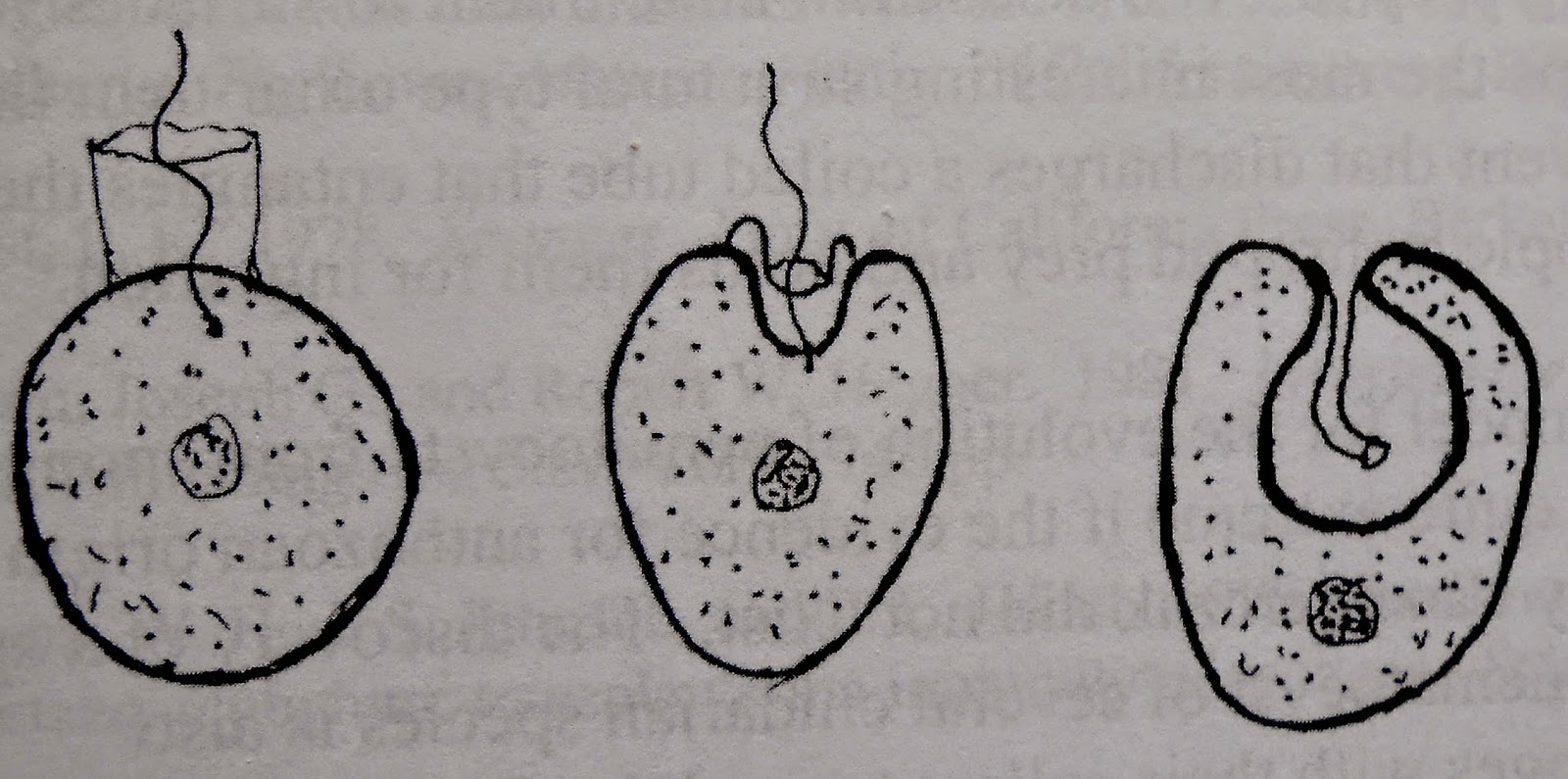
In view of the ease of evolving a complex structure from a pre-existing structure as compared to the difficulty of producing it from uniform structure, one of the above sequences seems likely. A different origin is not impossible, but one or both of the above seem to fit the action of natural selection.
Joseph G. Engemann April 8, 2015
Earlier posts have discussed the evolutionary path leading from sponges to anthozoans to hydrozoans to turbellarians. Gross structural comparisons were major contributors to that understanding. But the nematocysts, found in the Cnidaria, which are the basis for the phylum name, are such specialized cell organelles, and only produced in the Cnidaria, also contribute to understanding the sequence of the three phylum connection.
When nematocysts are occasionally found in another phylum, they originate from cnidarians preyed upon by those individuals that have them. Octopuses have been found to use cnidarian tentacle fragments along their own arms to obtain the benefits of nematocyst use. Some other mollusks digest cnidarians without disrupting the nematocysts which then arrive at their outer surface in a functional state.
Turbellarian rhabdites
The hydrozoan medusa-triclad turbellarian connection indicated by gross morphology fits well with the transition of nematocysts to rhabdites, the peculiar cell organelles in the epidermal cells of turbellarians. The tubule that everts from a nematocyst is no longer evident but the function of the secretions delivered may have survived or been modified to the ones of turbellarian's rhabites.
Nematocyst origin
Sponges have a plethora of chemicals of use for their protection. Being attached and lacking much to physically protect them, other than spicules, toxic and other obnoxious chemicals may have provided protection from many types of organisms. Spicules may have been coated with such chemicals and delivered them to both large and small potential predators. The discovery of spicules in the apex of some nematocysts or cnidarians provides inspiration for a structural transition from sponge spicule function to cnidarian nematocyst structure as diagrammed below.
A. A sponge cell with an emphasis on mechanical protection via a spicule.
B. Improved intermediate stage (hypothetical) with reservoir from chemicals coating spicule.
C. Selection yielding larger reservoir of chemicals (hypothetical).
D. Final stage- a nematocyst-containing cell of a cnidarian.
There are other possibilities for nematocyst origin that seem less likely now that some are known to have the apical spicule. One of those alternatives may have been transition from a choanocyte rather than from a spicule-secreting cell. It is possible, especially in view of the variety of nematocysts in hydrozoans, that more than one origin did occur, perhaps illustrated by the diagrams below.
In view of the ease of evolving a complex structure from a pre-existing structure as compared to the difficulty of producing it from uniform structure, one of the above sequences seems likely. A different origin is not impossible, but one or both of the above seem to fit the action of natural selection.
Joseph G. Engemann April 8, 2015
Wednesday, January 7, 2015
ICE STORMS
The Beauty of an Ice Storm

is often not appreciated.
The picture above was taken in January over thirty years ago of fruits on a small tree beside our house. Before the winter was over the berries were eaten by a flock of birds whose usual food had become snow covered or eaten.
In the spring, well after the ice storm, I looked up and saw slashes of light colored wood on the upper branches of big silver maple trees along the street. Throughout the city there had been many trees and large limbs broken down by the load of ice the trees bore. A coating of ice on the tips of upper branches presumably broke off many of the small upper twigs and lightened the load on the big branches so most trees survived.
About a dozen years ago we were in a different house when another ice storm hit. The most remarkable damage in our yard was a tall pine tree in a neighboring lot broke off and almost reached our house. I had noticed that the upper part was bending over under the weight of ice and better exposed the branches to more freezing rain and ice accumulation. During the night the trunk snapped off about ten feet above the ground.
The consequences of such events must have a selective role in the lives of many organisms. In a forest the occasional large tree falls and leaves an opening for sunlight to enable a new cycle of plant growth near the ground. The various plants have a role in feeding or hiding animals from small to big. Such complexities have no doubt been a feature of the environment organisms adapt to over time as they evolve to better compete. If they don't they join the throng of extinct species preceding them.
There are many natural disasters that do have a role in natural selection even though they arrive at unpredictable intervals and locations. Many of the disruptions we cause may affect the course of evolution, sometimes in ways similar to natural disasters, sometimes in ways that may be worse.
Joe Engemann Kalamazoo, MI January 7, 2015
is often not appreciated.
The picture above was taken in January over thirty years ago of fruits on a small tree beside our house. Before the winter was over the berries were eaten by a flock of birds whose usual food had become snow covered or eaten.
In the spring, well after the ice storm, I looked up and saw slashes of light colored wood on the upper branches of big silver maple trees along the street. Throughout the city there had been many trees and large limbs broken down by the load of ice the trees bore. A coating of ice on the tips of upper branches presumably broke off many of the small upper twigs and lightened the load on the big branches so most trees survived.
About a dozen years ago we were in a different house when another ice storm hit. The most remarkable damage in our yard was a tall pine tree in a neighboring lot broke off and almost reached our house. I had noticed that the upper part was bending over under the weight of ice and better exposed the branches to more freezing rain and ice accumulation. During the night the trunk snapped off about ten feet above the ground.
The consequences of such events must have a selective role in the lives of many organisms. In a forest the occasional large tree falls and leaves an opening for sunlight to enable a new cycle of plant growth near the ground. The various plants have a role in feeding or hiding animals from small to big. Such complexities have no doubt been a feature of the environment organisms adapt to over time as they evolve to better compete. If they don't they join the throng of extinct species preceding them.
There are many natural disasters that do have a role in natural selection even though they arrive at unpredictable intervals and locations. Many of the disruptions we cause may affect the course of evolution, sometimes in ways similar to natural disasters, sometimes in ways that may be worse.
Joe Engemann Kalamazoo, MI January 7, 2015
Wednesday, October 1, 2014
EVOLUTION: NUCLEOTIDE MUTATION RATES
Evolution: Nucleotide Mutation Rates
MOLECULAR CLOCKS
If nucleotide mutation rates were the same for all organism and all parts of the genome, they would be the basis for a perfect molecular clock to determine relationships for constructing evolutionary trees. But they are neither the same for all organisms nor even for various portions of the genome for the same organism.
For those wishing a more comprehensive view of the variables, they may be found by searching for nucleotide mutation rates in Wikipedia, or elsewhere, on the internet. To the best of my knowledge, my peers have neither found nor embraced the evidence I have presented in other posts on this blog showing the major errors in the current published articles on the relationships of phyla and the importance of the Pogonophora in demonstrating those relationships.
MUTATON RATE VARIABLES
Some variables are known but not considered in several major studies, thus producing major errors in proposed schemes of animal evolution. A variation produced by different generation times is the major factor affecting rates of origin of phyla when extremely low evolutionary rates occur - as noted elsewhere in this blog for pogonophorans and perhaps nematodes. Most variables would have a proportional affect within the variation caused by generation time. Fortunately, the affect of generation time diminishes to near zero as one approaches the species level.
Variables
There are many documented studies showing different rates for different groups of species.
1. Viruses with RNA genomes mutate at a much faster rate than organisms with DNA genomes.
2. Mitochondrial DNA has a faster mutation rate than nuclear DNA.
3. Methylated DNA is more resistant to mutation than DNA that is not methylated, as in sperm which have higher mutation rates than eggs. This is perhaps tied in with the fact that sperm genes may be expressed in the individual produced more than is expressed by genes from the egg. Methylated DNA from the egg may also be a reason that dosage affect on gene expression has less impact than one might expect from comparison with instances where three of a particular chromosome are present. The methylation effect is not total; that is shown by Medel's pea experiments where the flower pigment expressed is dosage dependent, and in humans where the sickle cell gene is less debilitating in the heterozygous condition.
4. Mutations are more likely to occur near sites where chromosomal deletion or insertions have occurred than in more distant locations from those mutated sites on the chromosome.
5. Genetic factors may affect rates; perhaps through variations in function of chromosomal damage repair functions. Rates may be subject to natural selection balancing the value of introducing change versus the stability desired in successful genes.
6. Environmental factors such as variation in background radiation and/or the extremes of deep sea pressure may also affect rates.
7. Generation time is the current source of error in relating major groupings of phyla. This error is also a factor in proposals of a time of origin of humans relative to monkeys and great apes. But it is not a factor in most studies of animals sharing the same species, genus, or family. However it may be more of a factor as one compares orders and classes of animals.
A botanist colleague maintains generation time is not a factor in evolution of flowering plants, although I think that has yet to be proven.
Generation time versus age affects?
The question might be of interest in human evolution because older individuals may be more likely to have experienced mutations in germ cells, especially sperm, whereas eggs may be spared much of the generation time effect by all being produced before birth as well as by having methylated DNA.
I have not given much thought to this as a general factor because it does not seem apparent for animals in the deep sea that were critical in providing the clue of the annelid ancestry of chordates. If long generation time corresponds with more mutations per individual, it would seem to cancel out to some extent the generation time effect in evolutionary rates. The extreme difference of generation time of abyssal animals critical in the early origin of phyla makes cancellation of this type of little importance when considering overall evolutionary trees of the major groups of animals.
Natural selection
The rate of mutations may not have as much to do with evolution as does natural selection. Beneficial mutations, although they are much rarer than other mutations, tend to be incorporated in the species gene pool via natural selection or survival and reproduction of the individuals having them. Whereas deleterious mutations tend to be eliminated. In mammalian species much of the genome is thought to be non-coding and in the regions of the chromosome between the genes or coding regions. Mutations in the non-coding regions are thought to be of little consequence as long as they maintain the chromosomal integrity.
Although rates are not necessarily of major impact on the direction of evolution, they are essential to consider in establishing the branching pattern of evolutionary trees, especially as regard major group relationships.
Joseph G. Engemann Emeritus professor of Biological Sciences, Western Michigan University October 1, 2014
Subscribe to:
Posts (Atom)